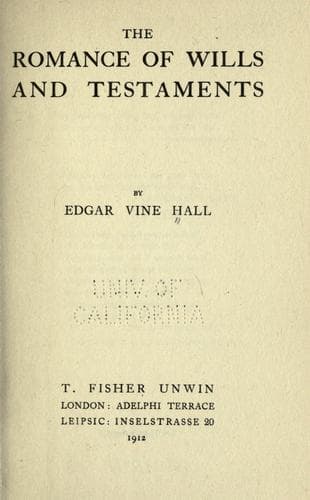
The Romance of Wills and TestamentsVine Hall, Edgar
History
The Romance of Wills and Testaments
Vine Hall, Edgar
Wills -- Great Britain -- Miscellanea
It is said that fear lest the spirit should not be at rest was the
origin of the priest’s injunction to the sick to make his will, an
injunction which still forms part of the “Visitation of the Sick” in
the Book of Common Prayer. “And if he hath not before disposed of his
goods, let him then be admonished to make his Will, and to declare
his Debts, what he oweth, and what is owing unto him; for the better
discharging of his conscience and the quietness of his Executors. But
men should often be put in remembrance to take order for the settling
of their temporal estates, whilst they are in health.” In other
chapters this subject has been touched, and instances have been given
of wills made in the hour of death. But when no will is made, no friend
is near, can the spirit of the dying or of the dead indicate his last
will? There are tales to this effect.
“During the cholera epidemic in the North of England, about 1867-8,
I remember an incident which had a great effect upon my boyish mind
at the time. I lived in North Shields, and was the favourite of my
great-grandmother, with whom I often stayed. The old lady was rather a
recluse in her habits, and occupied two upper rooms in her daughter’s
house. She was known to have some paper money about her, which,
however, she carefully concealed somewhere from all her relatives.
At the same time, it was known she had a particular partiality for
one certain cupboard which she used as a wardrobe in her bedroom....
At three o’clock one morning, while sleeping at my own home, I awoke
to find the old lady standing at the foot of my bed, calling to me
and beckoning to me to follow her. I sat up in bed, terrified at the
sight, but, of course, manifested no desire to move. The old lady then
became impatient, and saying she could not remain longer, begged of
me to be sure and go to ‘the cupboard,’ this being her usual phrase
when referring to the small wardrobe.... On the old lady’s departure
I was so frightened that I felt I dare not stay in the room.... I
awoke my mother and told her what had happened. She calmed me as much
as possible and saw me off to bed again, but in the morning she was
so much impressed with my story that she accompanied me on my way to
school, and we called to see if anything was wrong with the old lady.
Imagine our surprise on reaching the house to learn that she had been
found dead in bed a short time before our visit. The body was cold,
proving that she had been dead some hours, the doctor declaring she
had died of cholera. The inference formed was that she must have died
about the hour she visited me. Suffice it to say, an inspection of ‘the
cupboard’ revealed the fact that other hands had done duty there before
ours had a chance, but with what result will never be known.”
What such visions are, whether of the dying or of the dead, or
otherwise, is a subject of keen controversy, but is not our business
here.
Public-domain text, read in full here on John Shaqi.
Reviews
Reviews
No reviews yet
Be the first to share your thoughts on this work.
Elsewhere in the archive
Join the Discussion
Join the discussion
Sign in to leave a comment or review.
Sign InorCreate an account