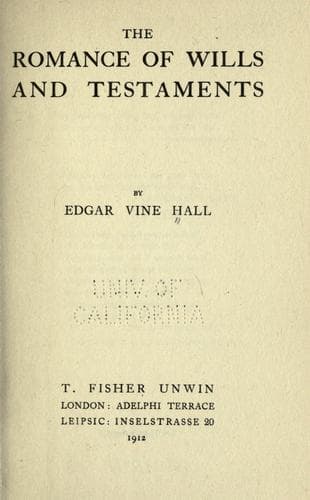
The Romance of Wills and TestamentsVine Hall, Edgar
History
The Romance of Wills and Testaments
Vine Hall, Edgar
Wills -- Great Britain -- Miscellanea
He calmly anticipates the acceleration with which he advances towards
death. But, now as formerly, he will not dogmatise on his salvation; he
“hopes” and “trusts.” “A man may have such a degree of hope as to keep
him quiet,” he had observed on one occasion; but on another, “No man
can be sure that his obedience and repentance will obtain salvation.”
He might have prayed, as did Sir Francis South in his will dated
November 14, 1631, “beseeching Him for the all-sufficient merits and
infinite mercies of His only Son and my alone Saviour Christ Jesus to
accept of this my poor sacrifice, and freely to pardon and forgive me
my many multiplied sins and transgressions, and in the love of His most
blessed Spirit to give me some comfortable assurance thereof during my
time in this vale of flesh, that I may joyfully and willingly part with
this miserable world to live with Him for ever in His eternal rest.”
It was this “comfortable assurance” that Johnson needed. To the last
he seems logically to have maintained the distinction between hope and
belief, but emotionally to have discarded it. Certainly at the end he
was resigned.
But Johnson could not comfort himself with the idea, prevalent
in his century, of the infinite goodness of God. He dismissed it
as inapplicable to his case, a few months before his death, in a
conversation with Dr. Adams. “‘As I cannot be _sure_ that I have
fulfilled the conditions on which salvation is granted, I am afraid I
may be one of those who shall be damned’ (looking dismally).” But it
is made a frequent ground of hope (for want of a better) in wills of
the time. John Murton, in a will proved the year of Johnson’s death,
thus begins: “In the Name of God, Amen. I, John Murton, of Milton next
Sittingbourne in the County of Kent, grocer, being advanced in years
and in an indifferent state of health, but of sound and perfect mind
memory and understanding, (praised be Almighty God for the same,) and
considering the uncertain continuance of this mortal life, and the many
hazards and dangers that we frail beings are daily liable and incident
unto, do make publish and declare this my last will and testament in
manner and form following, (that is to say:) First and principally of
all I commend my soul into the hands of Almighty God who gave it, in
all humble hopes and with a firm assurance of its future happiness as
in the disposal of a Being infinitely good.” Forty years previously
Pope employed the same sentiment and almost the same phrase: “I
Alexander Pope, of Twickenham in the County of Middlesex, make this my
last will and testament. I resign my soul to its Creator in all humble
hope of its future happiness as in the disposal of a Being infinitely
good.”
Public-domain text, read in full here on John Shaqi.
Reviews
Reviews
No reviews yet
Be the first to share your thoughts on this work.
Join the Discussion
Join the discussion
Sign in to leave a comment or review.
Sign InorCreate an account