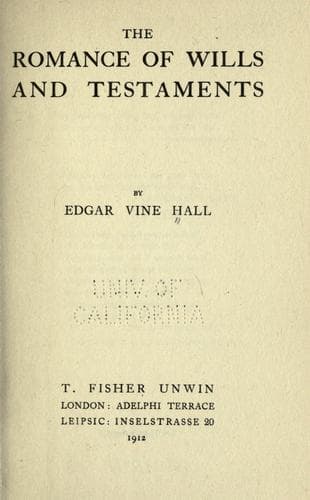
The Romance of Wills and TestamentsVine Hall, Edgar
History
The Romance of Wills and Testaments
Vine Hall, Edgar
Wills -- Great Britain -- Miscellanea
Another cause of non-fulfilment may be a legal barrier. There is no
legal method of enforcing a testator’s wishes for the disposal of his
body, except for anatomical purposes. The bequest is void if money be
given to expend the interest in keeping up a grave. In England there
is a legal obstacle against a bequest for the celebration of masses
for the repose of the soul: it is termed a “superstitious trust”
and is invalid. The famous decision in 1835 in the case of _West v.
Shuttleworth_ has not been superseded. The Master of the Rolls, Sir
Charles Pepys, afterwards Lord Cottenham, held that in this country
gifts to priests “that I may have the benefit of their prayers and
masses,” or “for the benefit of the prayers for the repose of my soul,
and that of my deceased husband,” were void, and void such bequests
remain.
Personal reasons, lastly, may bring about the breaking of a will.
Sir Edmund Bury Godfrey’s recommendations for his funeral have been
quoted: he desired to be buried in the meanest place, without pomp or
pageantry, without numerous attendants either of friends or relations,
very early in the morning or very late at night, as privately as
possible, without sermon or harangue. But the excitement and notoriety
of his end, the passions that it aroused or signified, could not suffer
him so to depart. His death and funeral are part of the history of his
time. On October 12, 1678, he disappeared: on the 17th he was found
dead in a ditch on the southern side of Primrose Hill. The funeral was
postponed till the 31st, when his body was borne to Old Bridewell, and
publicly lay in state. A solemn procession accompanied it through Fleet
Street and the Strand to St. Martin’s Church, where it was buried and a
sermon preached by the vicar, William Lloyd. Thus was his will wholly
set at nought—a remarkable but perhaps a pardonable violation.
CHAPTER III
DR. JOHNSON’S WILL
“My readers,” writes Boswell, “are now, at last, to behold Samuel
Johnson preparing himself for that doom from which the most exalted
powers afford no exemption to man.” There can be few sights more
fascinating. In the case of Johnson there is an especial fascination,
since for many years he felt, and at times expressed, fear and horror
of death in a degree to which most men are strangers. He said “he
never had a moment in which death was not terrible to him.” But toward
the end this horror abated, so that there is a peculiar beauty in the
opening of his will, which he made but five days before his death. “In
the name of God, Amen. I, Samuel Johnson, being in full possession
of my faculties, but fearing this night may put an end to my life,
do ordain this my last will and testament. I bequeath to God a soul
polluted with many sins, but I hope purified by repentance and I trust
redeemed by Jesus Christ.”
Public-domain text, read in full here on John Shaqi.
Reviews
Reviews
No reviews yet
Be the first to share your thoughts on this work.
Join the Discussion
Join the discussion
Sign in to leave a comment or review.
Sign InorCreate an account