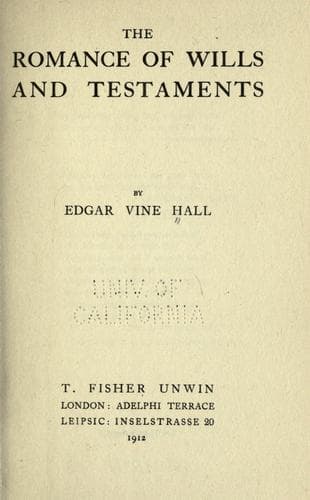
The Romance of Wills and TestamentsVine Hall, Edgar
History
The Romance of Wills and Testaments
Vine Hall, Edgar
Wills -- Great Britain -- Miscellanea
“Prepare for death, if here at night you roam,
And sign your will before you sup from home.”
He may have put it off from sheer indolence, but it is not unlikely
he felt something of the common superstition against making a will,
unreasonable though it may be and unwise. When Charles Lamb wished to
make his first will he wrote: “I want to make my will, and to leave
my property in trust for my sister. _N.B._ I am not going _therefore_
to die.” But Lamb had not Johnson’s peculiar dread of death. The
superstition is not yet defunct; its rise and origin would be difficult
to trace. “It is received,” says a writer in the sixteenth century,
“for an opinion amongst the ruder and more ignorant people, that if a
man should chance to be so wise as to make his will in his good health
when ... he might ask counsel of the learned, that then surely he
should not live long after.”
It is curious that it should sometimes be a case for jocularity if a
man make his will betimes. Possibly this light-heartedness is assumed
as a cloak to hide from ourselves the gravity of our inevitable end.
If this be so, it is not surprising to find Dr. Johnson convulsed with
hilarity when his friend Langton made his will. But the story is an
extraordinary one. “He now laughed immoderately, without any reason
that we could perceive,” says Boswell, “ ... called him the testator;
and added, ‘I dare say he thinks he has done a mighty thing. He won’t
stay till he gets home to his seat in the country, to produce this
wonderful deed: he’ll call up the landlord of the first inn on the
road; and, after a suitable preface upon mortality and the uncertainty
of life, will tell him he should not delay making his will.... He
believes he has made this will; but he did not make it; you, Chambers,
made it for him. I trust you have had more conscience than to make him
say, ‘being of sound understanding’; ‘ha, ha, ha! I hope he has left
me a legacy. I’d have his will turned into verse, like a ballad.’ ...
Johnson could not stop his merriment, but continued it all the way
till he got without the Temple-gate. He then burst into such a fit of
laughter, that he appeared to be almost in a convulsion; and, in order
to support himself, laid hold of one of the posts at the side of the
foot pavement, and sent forth peals so loud, that in the silence of the
night his voice seemed to resound from Temple-bar to Fleet-ditch.”
Public-domain text, read in full here on John Shaqi.
Reviews
Reviews
No reviews yet
Be the first to share your thoughts on this work.
Elsewhere in the archive
Join the Discussion
Join the discussion
Sign in to leave a comment or review.
Sign InorCreate an account