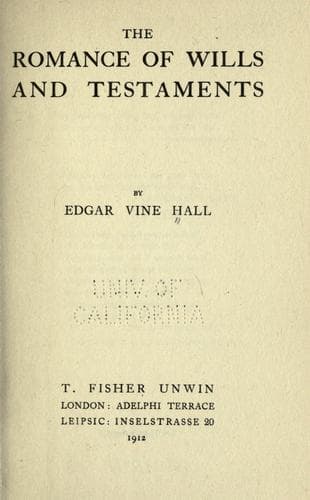
The Romance of Wills and TestamentsVine Hall, Edgar
History
The Romance of Wills and Testaments
Vine Hall, Edgar
Wills -- Great Britain -- Miscellanea
In spite of Dr. Johnson’s amusement, the early making of a will has
long been of grave concern to moralists. As Donne in one of his sermons
says, the execution of a will at the last may be a heavy business, but
the addition of a codicil, if necessary, may be easily dispatched. But
in wills themselves the most elaborate language is employed to force
home this precept. The will of Dame Jane Talbot, dated in the 20th
year of Henry VII., thus begins: “I Dame Jane Talbot, widow late the
wife of Sir Humphrey Talbot knight, calling to remembrance that the
gracious passage and departing from this transitory life dependeth and
ensueth upon a discrete will made by good deliberation in good and
virtuous order; and that I and all other Christian people be mortal and
must depart from the wretched uncertain and unstable life, the hour
and time of which departing from the same unstable life is uncertain;
and also that I and any other mortal person, be apt by the sending and
visitation of God to receive and take such infirmities and sickness
whereby I might, in or immediately before the article or pain of death,
lack or fail sure and perfect mind and reason to order and make my last
will and testament according to the meritorious and wholesome intent to
the will of my soul: wherefore I the said Dame Jane Talbot, being of
perfect health, whole mind and good memory, to the honour of God and
health of my said soul ordain and make this my testament and last will
in manner and form following; that is to say, First I bequeath and give
my soul unto my Lord God, Father of Heaven, which of His inestimable
and infinite mercy and goodness hath made it assemblable to His own
image, and of His infinite mercy with His precious blood hath redeemed
it, and to His blessed Mother the Virgin Saint Mary and also to the
charitable tuition and keeping of all the saints in Heaven.”
Johnson had not wife or children of his own to provide for, but he
had many friends. As already hinted, some of these he offended by
the omission of their names. For this reason also he displeased Lucy
Porter. Boswell (himself omitted) says that she should have considered
that she had left nothing to Johnson, though her will was made in his
lifetime. But it is fair to remark that she mentions few names in all,
and that her will was not executed until September in the year of
Johnson’s death.
Public-domain text, read in full here on John Shaqi.
Reviews
Reviews
No reviews yet
Be the first to share your thoughts on this work.
Elsewhere in the archive
Join the Discussion
Join the discussion
Sign in to leave a comment or review.
Sign InorCreate an account