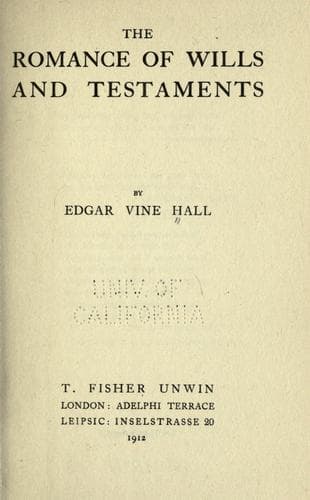
The Romance of Wills and TestamentsVine Hall, Edgar
History
The Romance of Wills and Testaments
Vine Hall, Edgar
Wills -- Great Britain -- Miscellanea
Provision for old servants is still a frequent, even an outstanding,
feature of wills, accompanied often by graceful expressions of
gratitude. Perhaps it has always been so. The Rt. Hon. Humphry Morice,
of the Privy Council, was writing a codicil by way of instruction to
his executors, shortly before the year of Johnson’s death. He makes us
feel vividly what Johnson must have owed to his faithful servant: “My
diamond shoe and knee buckles I mean to include in my wearing apparel
left to Richard Deale, also gold-headed canes, as his attention and
fidelity increases every day, and sorry I am to say he is the only
servant I ever had who seemed sensible of good treatment and did not
behave ungratefully.”
To the ordinary reader Dr. Johnson’s other bequests appear
thoughtful too, though Hawkins considered them ill-proportioned and
ill-calculated. To the Rev. Mr. Rogers, of Berkeley, near Frome, he
gave £100, “requesting him to apply the same towards the maintenance
of Elizabeth Herne, a lunatick”; to his god-children, “the son and
daughter of Mauritius Lowe, painter, each of them £100 of my stock in
the 3 per cent. consolidated annuities, to be applied and disposed
of by and at the discretion of my executors, in the education or
settlement in the world of them my said legatees”; and to “Mr. Sastres,
the Italian master, the sum of £5, to be laid out in books of piety
for his own use.” But uppermost in his mind, it would seem, was
the debt of gratitude he owed, for his father’s sake, to Innys the
bookseller; for him he remembered in his will made in the immediate
apprehension of death, while most of his bequests occurred in the
codicil executed on the following day.
One of the strangest characteristics of man is that, in the face of
death, he can without a qualm speak bitter words and cherish hard
feelings, a characteristic which sometimes distinguishes or disfigures
wills. Dr. Johnson’s will is free from any such taint. Yet he retained
a certain roughness of language to the last. “Treat thy nurses and
servants sweetly, and as it becomes an obliged and a necessitous
person,” says Jeremy Taylor. Boswell speaks of Johnson’s “uncommon
kindness to his servants.” But, asked one morning how he liked a new
attendant who had sat up with him, Johnson replied with a touch of his
old humorous self: “Not at all, Sir; the fellow’s an idiot; he is as
awkward as a turnspit when first put into the wheel, and as sleepy as a
dormouse.”
Public-domain text, read in full here on John Shaqi.
Reviews
Reviews
No reviews yet
Be the first to share your thoughts on this work.
Elsewhere in the archive
Join the Discussion
Join the discussion
Sign in to leave a comment or review.
Sign InorCreate an account