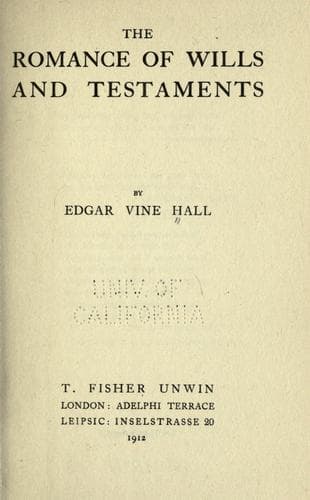
The Romance of Wills and TestamentsVine Hall, Edgar
History
The Romance of Wills and Testaments
Vine Hall, Edgar
Wills -- Great Britain -- Miscellanea
Thus even so simple a document as Johnson’s will occasioned searchings
of heart, a result that some strive heroically or pathetically to
avoid. “I again desire that all things may be composed with peace
honour and honesty,” wrote Dorothy Eve, of Canterbury, in 1691.
A merchant, James Clegg, whose will was proved the same year as
Johnson’s, declared that he made his testament “to explain my last
will for the distribution of what shall result to be my property and
to me belonging at the time of my decease, in such manner that I hope
not to embroil those persons who will have the pleasure of surviving
me.” Wills that stir the passions and sting the memory are indeed of
frequent occurrence. Wills that satisfy every friend must surely be few.
To what an extent the remembrance of friends may be carried is
illustrated by a will made a few years after Johnson’s death. While
Johnson bequeathed books to less than a score of friends, Martha
Shorte, in a list which must long have engaged her thoughts, bequeaths
mementoes to more than a hundred beneficiaries. “The small trifle,”
she says in one place, “is only to denote that all my kind neighbours
lived in my memory.” In some cases it may be surmised, or at least the
suspicion will cross the mind, that her friends were not unaware of her
testamentary tendencies. To one, for instance, she gives “two mahogany
stools that she used to like,” to another, “an old inlaid Chinese
cabinet that she always admired,” to another the “yew-tree card-table
which she admired.” But there is a danger in lavish remembrance: for if
one be omitted where many are comprised, the sting is so much the more
sharp.
Johnson left the residue of his estate to his negro servant, Francis
Barber. Even this raised dissent. Sir John Hawkins, says Boswell,
seemed not a little angry at this bequest, and muttered a caveat
against ostentatious bounty to negroes. Barber had once been a slave,
but had received the gift of liberty under his master’s will. The
latter years of his liberty Johnson hoped to provide for.
Simpson Strachan, the merchant whose will was buried for fear of the
enemy, may illustrate the case of Barber. “My will and my intention is
that my negro man ... in virtue of his faithful services be made free
of all slavery whatever, and I do hereby order and ordain and request
my executors to pay all the expenses attending his freedom from my
estate, and that they give him the sum of £330 currency to his own
use and behoof as a reward for his fidelity and attachment to me.”
Most would agree with Boswell that a faithful servant, in lieu of near
relations, is peculiarly entitled to enjoy
“A little gold that’s sure each week,
That comes not from his living kind,
But from a dead man in his grave,
Who cannot change his mind.”
Nor was it his master’s fault if Barber made so ill a use of his money
as Hawkins affirms.
Public-domain text, read in full here on John Shaqi.
Reviews
Reviews
No reviews yet
Be the first to share your thoughts on this work.
Elsewhere in the archive
Join the Discussion
Join the discussion
Sign in to leave a comment or review.
Sign InorCreate an account