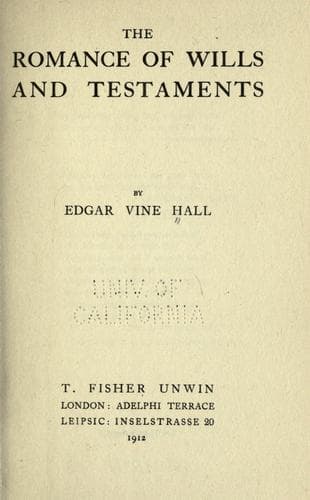
The Romance of Wills and TestamentsVine Hall, Edgar
History
The Romance of Wills and Testaments
Vine Hall, Edgar
Wills -- Great Britain -- Miscellanea
These wills, spoken by those stricken with the plague and in many
cases carefully recorded, show that the poor creatures were not always
deserted in their sickness. Writers make much of the many devices to
escape contagion, but Nicholas Holmes actually did not hesitate to
take a legatee by the hand. “Memorandum that Nicholas Holmes, late of
the parish of St. Dunstan’s in the West, Gent., upon the third day of
October in Anno Domini 1636, being taken sick of his last sickness
whereof he died, being in perfect mind and memory, did publish and
declare his last will and testament nuncupative in manner and form
following, viz.: he said that he was suddenly taken so sick that he
thought he should die of the sickness, and thereupon he took Mary
Willowe, the daughter of John Willowe of the said parish, clockmaker,
by the hand and said, ‘Mary, if I die I do give thee an hundred
pounds’: and he further said that he did not know how his landlord
might be prejudiced by his death, in case he should die of the sickness
in his house; therefore he said that, if he died of the sickness, he
would give him threescore pieces.”
A landlord who did not turn away one who was sick of the sickness
might merit gratitude, as surely would masters who did not dismiss
their servants. There was no Insurance Act in those days. “The case of
poor servants was very dismal,” says Defoe of the plague in 1665, and
doubtless it was so at every visitation. Servants, it is said, were the
chief frequenters of astrologers and quacks, who hung out their signs
in almost every street. “Oh! Sir,” they would ask, “for the Lord’s
sake, what will become of me? Will my master, or mistress, keep me, or
turn me off? Will they stay here or go into the country? Will they take
me with them, or leave me here to be starved and undone?” Poor William
Aspinall was one of the unfortunates. “Memo. that at or upon the 17th
day of July, 1603, or thereabouts, William Aspinall late servant unto
Richard Leaver of the parish of Allhallows, Barking, in London, being
visited with the sickness, but of perfect mind and memory, made and
declared his last will and testament nuncupative in manner and form,
or to the like effect here following, viz.: he bequeathed his soul to
God, and his body to the earth. And as concerning his master Richard
Leaver before mentioned, he said he had done him the best service he
could, and had dwelt with him a long time, and had served him truly
and honestly to the uttermost of his power; and in requital thereof
his said master had dealt very unkindly with him, and in the time of
his first sickness did forbid him his house and bid him seek lodging
elsewhere, and by no means would in that his first time of need suffer
him to lodge within his doors, which he took very unkindly.” It is
only fair to mention that, on the Friday following, he relented to the
extent of giving to his master and mistress each a pair of gloves, to
be bought at ten shillings the pair.
Public-domain text, read in full here on John Shaqi.
Reviews
Reviews
No reviews yet
Be the first to share your thoughts on this work.
Elsewhere in the archive
Join the Discussion
Join the discussion
Sign in to leave a comment or review.
Sign InorCreate an account