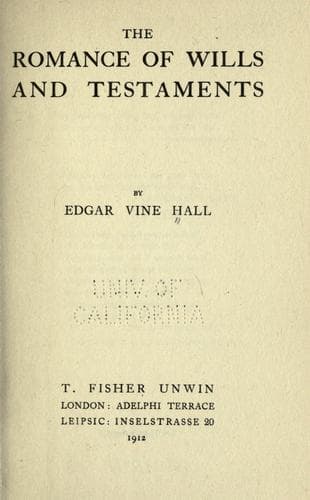
The Romance of Wills and TestamentsVine Hall, Edgar
History
The Romance of Wills and Testaments
Vine Hall, Edgar
Wills -- Great Britain -- Miscellanea
It is impossible to give a just idea of these documents, covering a
period of thirty-five years of changeful life. He is constantly putting
on patches, until the whole becomes a piece of motley. He seems to have
expected death more than once. The first paper, dated 13th of April,
1724, begins: “I Thomas Cheyney, fellow of the College near Winchester,
being by God’s will at this time of a sound mind, though labouring
under great bodily infirmities, which daily call upon me to remember
my latter end, have ... wrote this my last will and testament.” The
second paper, dated November 3rd of the same year, is addressed to his
mother. “Hond. Madam, As I have by will given the greatest part of my
estate entirely into your disposal (being desirous you should enjoy it
and be made as happy as possible while in this world) I make no doubt
but, if you survive me, you will as well out of regard to justice as
my request immediately after my death make a will, and therein take
effectual care of what I here recommend to you.... This I have writ in
haste to supply the defects of my will now made, in case I die before I
make a new one, which I intend in a few months when my affairs will be
better settled, if it please God to spare me so long.” The fourth paper
is dated June 5, 1732, and begins, “Now about to go to London, in case
I never return.”
But the last papers, which he regarded as his real will and codicil,
were made when death was not far from him, on July 4 and 6, 1759.
The will begins: “I Thomas Cheyney, Dean of the Cathedral Church of
Winchester, being now of sound mind and not forgetful of my mortality
do make and declare this to be my last will and testament, hereby
revoking all other wills formerly by me made, which however are not
destroyed, because they may, though of no validity in law, be of some
use to my executors. And first I recommend into Thy hands, Almighty and
Everlasting God, my immortal soul, beseeching Thee in all changes to
keep it close unto Thyself, and that I may in the day of Judgment find
such mercy as I shall stand in need of, thro’ the merits of a blessed
Redeemer.” It is in the codicil that he desires secrecy, as already
mentioned, and he concludes by desiring his executors to “destroy
unread all such letters as they know or suspect to be of the Duchess of
Devonshire’s writing, and to take all proper care that no other letters
may be divulged.”
CHAPTER VII
EIGHTEENTH-CENTURY PIETY
“Thou say’st thy _will_ is good, and glory’st in it,
And yet forget’st thy Maker ev’ry minute:
Say, _Portio_, was there ever _Will_ allow’d
When the testator’s _mem’ry_ was not good?”
QUARLES.
Public-domain text, read in full here on John Shaqi.
Reviews
Reviews
No reviews yet
Be the first to share your thoughts on this work.
Elsewhere in the archive
Join the Discussion
Join the discussion
Sign in to leave a comment or review.
Sign InorCreate an account