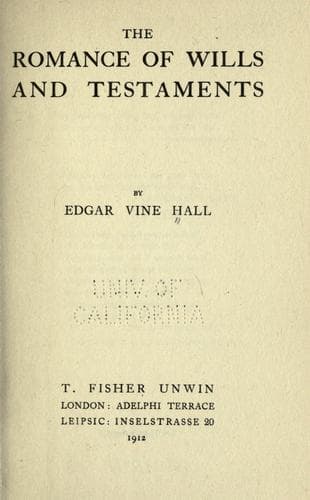
The Romance of Wills and TestamentsVine Hall, Edgar
History
The Romance of Wills and Testaments
Vine Hall, Edgar
Wills -- Great Britain -- Miscellanea
Genuine wills in rhyme are naturally rare, but literature is full of
imaginary or fantastic testaments, as well in prose as in verse. To
such a one Sir Walter Scott refers in a letter to Lady Anne Hamilton:
“I always remind myself of the bequest which once upon a time the wren
made to the family of Hamilton. This magnanimous, patriotic bird, after
disposing of his personal property to useful and public services, such
as one of his legs to prop the bridge of Forth and the other to prop
the bridge of Tay, at length instructs his executors thus:—
“And then ye’ll take my gallant bill,
My bill that pecks the corn,
And give it to the Duke of Hamilton
To be a hunting horn.”
Whether in prose or in verse—verse not seldom prosaic—a striking
similarity of idea runs through them, from the will of the _cochon_ of
the fourth century, who gives his teeth to the quarrelsome, his ears to
the deaf, his muscles to the weak, down to the will of Chatterton in
the eighteenth century, who gives “all my vigour and fire of youth to
Mr. George Catcott, being sensible he is most in want of it,” and “from
the same charitable motive ... unto the Rev. Mr. Camplin, senior, all
my humility.”
On earth all things decay and have their period, so all things may make
their wills.
“Omnia tempus edax depascitur, omnia carpit,
Omnia sede movet, nil sinit esse diu.”
The idea may be indefinitely extended. Among the writings of Thomas
Nash, for instance, is a fantasy entitled “Summer’s Last Will and
Testament.”
_Summer loquitur._
“Enough of this, let me go make my will....
The surest way to get my will performed
Is to make my executor my heir,
And he, if all be given him, and none else,
Unfallibly will see it well performed.
Lions will feed, though none bid them fall to,
Ill grows the tree affordeth ne’er a graft.
* * * * *
This is the last stroke my tongue’s clock must strike
My last will, which I will that you perform:
My crown I have disposed already of.
Item, I give my withered flowers and herbs
Unto dead corpses, for to deck them with;
My shady walks to great men’s servitors,
Who in their masters’ shadows walk secure;
My pleasant open air, and fragrant smells,
To Croydon and the grounds abutting round;
My heat and warmth to toiling labourers,
My long days to bondmen and prisoners—
My fruits to Autumn, my adopted heir,
My murmuring springs, musicians of sweet sleep,
To murmuring malcontents, with their well-tuned ears,
Channelled in a sweet falling quatorzain,
Do lull their ears asleep, listening themselves....”
Peignot, in his “Choix de Testaments” (1829) made a beginning of a
bibliography of imaginative or imaginary wills, among which he cites
the last will of the _Ligue_ in the “Satyre Ménippée.” It has eloquent
and poignant passages.
Public-domain text, read in full here on John Shaqi.
Reviews
Reviews
No reviews yet
Be the first to share your thoughts on this work.
Elsewhere in the archive
Join the Discussion
Join the discussion
Sign in to leave a comment or review.
Sign InorCreate an account