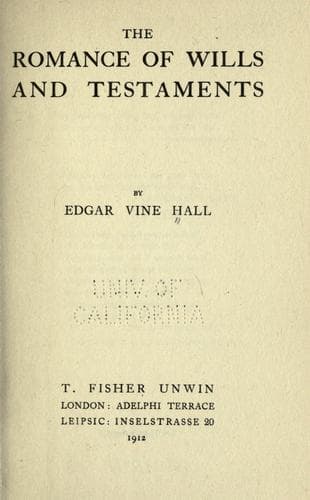
The Romance of Wills and TestamentsVine Hall, Edgar
History
The Romance of Wills and Testaments
Vine Hall, Edgar
Wills -- Great Britain -- Miscellanea
Thomas Smith Panuwell, of Tonbridge, seems not to have had much faith
in peaceableness and honesty: to his will is appended the following:
“As the above written was copied from a will written by me some time
before the above date, (1779) but not witnessed as I lay very ill of
a fever, I was dubious and revolving it in my mind whether it was
authentic, I had it written afresh by an attorney in form of law;
... but as I am now sensible my brain was then in perplexity through
weakness, the authenticity of this will might be questioned and
possibly for the benefit of trade by the man who wrote it, I hereby
declare it is my will, now it has pleased the merciful Almighty to
raise me from the jaws of Death and bless me with opportunity to
endeavour to attain through a sincere repentance and reform the
salvation of my spirit; and I am in perfect and sound mind and memory.
Witness my hand and seal this 20th day of February, 1780.”
Few cases in the courts are more interesting than doubtful or disputed
wills. But, however romantic, there is much that is sordid and
miserable in probate actions, much lamentable bitterness of spirit. It
may be hoped that when these cases are heard the testator has drunk
deep of the Lethean stream. But the controversy may begin before the
testator’s death, and cruel such wrangling is.
The story of the last days in the life of Elizabeth, mother of John
Stow, is a curious tale at once comic and distressing. John appears
not to have been on the best of terms with his family, and especially
to have irritated his younger brother Thomas. Elizabeth Stow, in 1568,
was living with Thomas and his wife, but one day chanced to go and
visit her son John. She was refreshed with the “best ale and bread, and
a cold leg of mutton was put before her, whereof she ate very hungerly,
and thereafter fell both to butter and to cheese.” On leaving, she
promised John not to slight him, as he was her eldest son. But Thomas
and his wife would give her no rest till she had told them all that
she and John had spoken together. It leaked out that John had insulted
Thomas’s wife, whereupon he “would never let my mother rest” (John
tells the story himself) “till he had forced her to break her will,
wherein she bequeathed me X li., (equal with all the younger children,
except Thomas, which had all indeed) and to put me in nothing at all.”
But she found that her friends would not witness the will, nor did they
until Thomas pretended he had restored the £10, though he put down £5,
in fact. “And so they set their hands to it, and after heard it read,
wherein they found the V li. and would have withdrawn their hands
again, but it was too late.”
Public-domain text, read in full here on John Shaqi.
Reviews
Reviews
No reviews yet
Be the first to share your thoughts on this work.
Elsewhere in the archive
Join the Discussion
Join the discussion
Sign in to leave a comment or review.
Sign InorCreate an account