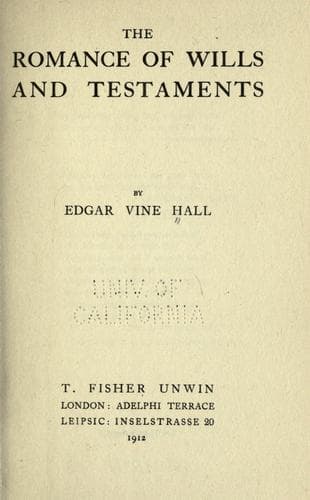
The Romance of Wills and TestamentsVine Hall, Edgar
History
The Romance of Wills and Testaments
Vine Hall, Edgar
Wills -- Great Britain -- Miscellanea
Such feuds and sorrows struck the imagination of Dickens, when he
visited Doctors’ Commons, where the wills which now rest at Somerset
House were stored in his day. “We naturally fell into a train of
reflection as we walked homewards, upon the curious old records of
likings and dislikings; of jealousies and revenges; of affection
defying the power of death, and hatred pursued beyond the grave, which
these depositories contain: eloquent by striking tokens, some of them,
of excellence of heart and nobleness of soul; melancholy examples,
others, of the worst passions of human nature. How many men as they lay
speechless and helpless on the bed of death, would have given worlds
but for the strength and power to blot out the silent evidence of
animosity and bitterness, which now stands registered against them in
Doctors’ Commons!”
It is curious how quickly a man turns to his will in the event of
coolness or misunderstanding. Cardinal Vaughan has told how his
friendship with Cardinal Manning died down. “We consulted one another
and told one another everything. Well, he had appointed me to be one of
his executors. On one occasion when I was staying with him in London,
we got into a discussion; I could not accept his views, and I suppose,
on the contrary, strongly maintained my own. I saw he was a little bit
put out—but what do you think he did? He went upstairs, took out his
will, and struck his pen through my name as executor.”
An uninitiated reader of Elizabeth Stow’s will would never have
known what bitterness lay behind that £5 legacy; but sometimes such
bitterness is evident enough. Harry Staple, of Ospring, Kent, whose
will is dated February 19, 1691, is curt and downright: “To the widow
Hall of Ospring and unto my three undutiful daughters, Mary and
Elizabeth and Martha one shilling apiece.” John Braibroke, of Cooling,
in 1535 requested his son Thomas “not to meddle with nothing of my
testament or last will, nor my wife Alice to meddle with nothing that
is or hath been between me and my son Thomas from the beginning of
the world unto the present day.” A startling bequest was that of 3½d.
to a son for the purchase of a rope for his wife, to be used as soon
as possible. And another son to reap trouble was Freeman Ellis, whose
father’s will was proved in 1664.
“Memo. that Freeman Ellis late of the parish of St. James
Clerkenwell ... having a very great love and affection for
Bridget Fanny and Judith Ellis who had always been very
kind and loving to him, and being very much displeased
with his son Freeman Ellis, who had been undutiful to him
and married without his consent and was gone away from his
wife, would and did several times in his life time ... say
and declare that whenever he died he would make his said
sisters ... his executrixes and leave his estate to their
sole ordering and disposing.”
Public-domain text, read in full here on John Shaqi.
Reviews
Reviews
No reviews yet
Be the first to share your thoughts on this work.
Elsewhere in the archive
Join the Discussion
Join the discussion
Sign in to leave a comment or review.
Sign InorCreate an account