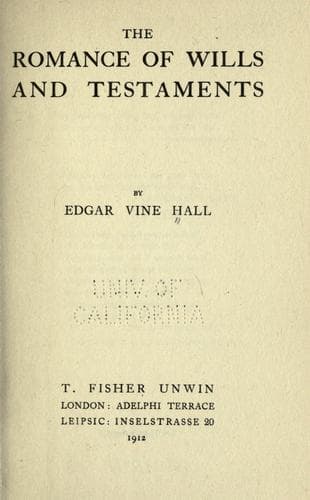
The Romance of Wills and TestamentsVine Hall, Edgar
History
The Romance of Wills and Testaments
Vine Hall, Edgar
Wills -- Great Britain -- Miscellanea
It is easy to discover such ugly facts as have just been disclosed.
But love and gratitude are certainly more frequent. In many cases
we see a picture of sweet and gentle family life, or of tender and
affectionate regard. It is delightful to meet in modern wills, as
one often may, expressions of passionate devotion and admiration for
a wife or husband. And in old wills we have many a charming picture
suggested. Sir Hugh Cholmley, a prominent figure in Whitby in the
seventeenth century, gives “to my dear brother, Sir Henry Cholmley, my
bay bald Barbary mare, called Spanker,” “to my dear daughter-in-law,
wife to my son William Cholmley, the green cloth hangings wrought with
needlework, which I desire her to esteem because they were wrought by
my dear wife and her servants when we were first housekeepers,” and
“to my dear sister, Mrs. Jane Twysden, wife to my brother Serjeant
Twysden, a little gold pot of ten pounds price, with hearty thanks
and acknowledgments for her many favours and kindnesses to myself and
children.”
John Pybus, who died in June, 1789, appears to have had a felicitous
family life, and though the language is the language of the eighteenth
century, the feeling would seem to be sincere and deep. “I also give
and bequeath unto my said wife the sum of £200, ... hereby declaring,
as in justice I think due to her, the very high opinion I entertain
of her temper and disposition, and how much I think myself obliged to
her for the very dutiful tender and affectionate conduct she has ever
given proofs of both as a wife and mother, during the whole course of
our matrimonial connection now nearly thirty-four years.” It is an
echo of the words of Robert Sanderson, Bishop of Lincoln, who died on
January 29, 1662, leaving his residuary estate “to my very loving and
dearly beloved wife, with whom I have lived almost three and forty
years in perfect amity, and with much comfort.” Philip Doddridge, D.D.,
a testator who had the knack of making his will interesting, has a
special paragraph about his wife: “And I hereby recommend her to the
divine supporting presence and care during the short separation which
her great love to me will, I fear, render too painful to her, praying
earnestly that God may succeed her pious care in the education of our
dear children that they may be happy for time and for eternity.” His
tender love is seen also in the superscription to a letter found among
his MSS. “To my trusty and well beloved Mrs. Mercy Doddridge, the
dearest of all dears, the wisest of all my earthly councillors, and of
all my governours the most potent, yet the most gentle and moderate”
(1741).
Public-domain text, read in full here on John Shaqi.
Reviews
Reviews
No reviews yet
Be the first to share your thoughts on this work.
Elsewhere in the archive
Join the Discussion
Join the discussion
Sign in to leave a comment or review.
Sign InorCreate an account