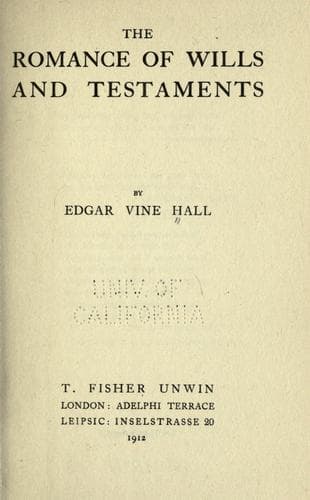
The Romance of Wills and TestamentsVine Hall, Edgar
History
The Romance of Wills and Testaments
Vine Hall, Edgar
Wills -- Great Britain -- Miscellanea
the aforesaid waxen model or bust of his said dear wife Amelia, in
testimony of my regard for him, and the respect I have for his domestic
character which has induced me to consider him as the best entitled to
this striking resemblance of his said dear wife, and whereon I have
ever set a very high value.
“I also give and bequeath unto Mr. Hollingbery, an officer in the Royal
Navy, the sum of 20 guineas for mourning, most sincerely wishing him
health happiness and prosperity through life, trusting his behaviour
will continue to be such as to merit success and do credit to the
assistance I afforded him on his first setting out in the world, which
I reflect on with the most real satisfaction.”
So John Pybus looks upon the world with a benignant and beneficent eye,
happy in his family and his friends, in his life and in his death.
CHAPTER XII
THE SERVANT PROBLEM
“O good old man! how well in thee appears
The constant service of the antique world,
When service sweat for duty, not for meed!
Thou art not for the fashion of these times,
Where none will sweat but for promotion,
And having that, do choke their service up
E’en with the having: it is not so with thee.”
Such are the reflections of Orlando upon the decay of service in “As
You Like It.” That ingratitude and incivility are not a monopoly of
to-day may be seen from such wills as those of Dr. Messenger Monsey
and of the Rt. Hon. Humphry Morice. The servant problem, indeed, often
forms a diverting feature of wills. And since in current wills we find
frequent instances of constancy and corresponding reward, doubtless the
lament over the “constant service of the antique world” is one among
many cases where the cry of _ætas parentum_ is erroneous or misleading.
In Hone’s “Table Book” is this memorandum: “The following memorial I
copied from a tablet, on the right hand side of the clergyman’s desk,
in the beautiful little church at Hornsey. The scarceness of similar
inscriptions makes this valuable.—S. T. L.
“Erected to the memory of Mary Parsons, the diligent,
faithful and affectionate servant in a family during a
period of 57 years. She died on the 22nd day of November,
1806, aged 85.
“Also to the memory of Elizabeth Decker, the friend and
companion of the above; who, after an exemplary service of
47 years in the same family, died on the 2nd of February,
1809, aged 75.
“Their remains, by their mutual request, were interred in
the same grave.”
But against such examples of a hundred years ago may be set wills like
those already mentioned. Dr. Monsey is characteristically vigorous
in speaking of his servant Nanney. “This she must take as a reward
for her impertinence, sauciness and unwilling service; she’s as proud
as the Devil can make her, as much of a prude as the best of you, as
self-conceited and pert and self-sufficient as the most flaunting
Duchess in the Kingdom.”
Public-domain text, read in full here on John Shaqi.
Reviews
Reviews
No reviews yet
Be the first to share your thoughts on this work.
Elsewhere in the archive
Join the Discussion
Join the discussion
Sign in to leave a comment or review.
Sign InorCreate an account