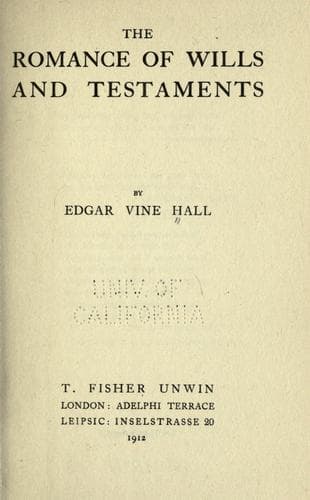
The Romance of Wills and TestamentsVine Hall, Edgar
History
The Romance of Wills and Testaments
Vine Hall, Edgar
Wills -- Great Britain -- Miscellanea
There is a phrase which is perhaps something of a stock phrase in
wills, but shows that the servant in the seventeenth century was more
than a chattel. It occurs, for instance, in the will of John Donne—his
real will, not that fantastic one he made in verse. He made it “in
the fear of God, whose mercy I humbly beg and constantly rely upon
in Christ Jesus, and in perfect love and charity with all the world,
whose pardon I ask from the lowest of my servants to the highest of my
superiors.” His will reveals that tender beauty which often appears
in these documents. Some of its legacies and provisions are quoted
by Izaac Walton, who, however, omits the most touching of all, the
interest of £500 “for the maintenance of my dearly beloved mother, whom
it hath pleased God after a plentiful fortune in her former times to
bring in decay in her very old age.” But this is a digression.
Nancy Greensill, widow, of Brewood, Staffs., in her will dated January
4, 1786, remembered her servant, but not in a spirit so generous. She
begs her mother Susannah will accept her cowslip wine as a small token
of affection; she gives to her brother-in-law Francis Greensill her
plain dressing-table with the smallest swing looking-glass and her
preserves of all kinds, and to his wife Fanny all her best shoes “as
I think they will best fit her.” She begs her sister-in-law Elizabeth
“will accept my pink and black striped silk gown, one of my best
worked aprons and my ear-rings of all kinds.” But to her servant Sarah
Williams she gives “my old wearing apparel, my worst pair of stays, my
old brown cotton gown, my black stuff gown, my light striped chintz
gown, my black quilted petticoat, old green petticoat, my bed gowns,
my worst mourning cap, three plain muslin handkerchiefs, my common
shoes, some thread stockings and my black bonnet.” And Mary Myddelton,
who died in 1789, good as it was of her to remember her washerwoman at
all, seems to spoil the gift to her of £2 by adding “with the worst of
my things that my executrix may think proper to give.” Still, it is
worth noticing that even a daughter comes in for a similar gift. Sarah
Morgan, of Glamorgan, in 1802 desires her executor to give “all the bed
linen and table linen to my daughter Kate Williams; they are not worth
sending to London, so old and very bad.”
Public-domain text, read in full here on John Shaqi.
Reviews
Reviews
No reviews yet
Be the first to share your thoughts on this work.
Elsewhere in the archive
Join the Discussion
Join the discussion
Sign in to leave a comment or review.
Sign InorCreate an account