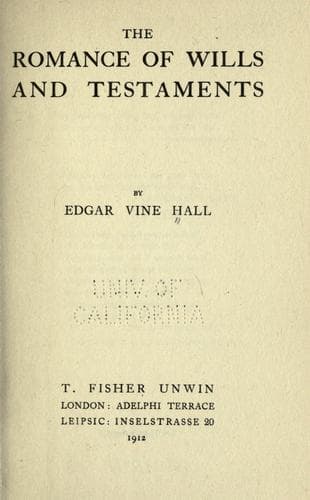
The Romance of Wills and TestamentsVine Hall, Edgar
History
The Romance of Wills and Testaments
Vine Hall, Edgar
Wills -- Great Britain -- Miscellanea
“I do not want her to be kept alive and miss my loving care,” said
a testatrix recently of a pet schipperke named Susie, and desired,
therefore, that she should be painlessly and expeditiously destroyed,
not sent to a dog’s home and put in a lethal chamber to be “frightened
by a lot of strangers.” This will was disputed in the court but its
validity upheld. Another testatrix directed that as soon as possible
after her death her pet cats Tiger and Darkey, her dog Nip, and her
horse Boy, should be humanely put to death by a veterinary surgeon
in the presence of her coachman, to whom she left the carcass of the
horse and £150. An eccentric testator often shows his eccentricity in
more than one provision of his will. A wealthy member of a Grantham
firm directed that his remains should be buried as quietly as possible
between those of his two brothers; that no females should attend his
funeral, stating that he made this provision to prevent unnecessary
pain to his wife; and that his old shooting pony Tommy should be shot
within fourteen days of his death and buried with its skin on, unless
his son should particularly desire to have the skin.
In old days, perhaps, testators were less unwilling for their animals
to pass to others. Ralph Bigod, of Seaton (1545), gives “to my nawnte
Warrayn the graie horse whiche I had of her, if he goo streght, and if
he goo not streyghte, then she to have the white amblinge mare whiche
I had of Maister Baites.” Thomas Brigham (1542) bequeaths his “great
hawke” to his brother-in-law; and John FitzThomas, of Bilton Park
(1541), “one cople of houndes and their lyomes [leashes], and one black
begill and his lyome and his coller” to “my lorde of Combrelande.”
John Coward, of Westpennard, Somerset, whose will is dated the 9th of
October of the 32nd year of Queen Elizabeth, gives therein to his
brother Thomas “my greate clocke nowe in my house goynge. To William
Watkynnes my little clocke ... nowe to be emended.” In a codicil, dated
the 9th of January of the 34th year of Elizabeth, he gives to Mary
Watkynnes “my best baye amblinge mare.” To his son Thomas Coward, “my
best geldinge yf he be not taken for a heryott. And unto Edward Coward
my sonne the other geldinge. Yf any of theise geldinges be taken for
an heryot, then my will and intent is that by my overseers a choice
be made of the fittest and best colte I have to make a geldinge when
they ar in theire pryme at sommer. I give allso to William Wilkynnes,
gentleman, (choice being first made for my sonne) one other colte to
make hym a geldinge at the pryme tyme in sommer, when they ar best
in shewe. Item. I give to Richard Siote, my guide, a good heiffer
yerelinge, a fustian dublett, my best white frise jerkin, a payer of
breches parte of the velvett being worne awaye with my sworde, and a
payer of russett stockinges. Item. I give unto Elizabeth Kitchen the
cloathe which she hathe in keepinge to make me a shirte.”
Public-domain text, read in full here on John Shaqi.
Reviews
Reviews
No reviews yet
Be the first to share your thoughts on this work.
Elsewhere in the archive
Join the Discussion
Join the discussion
Sign in to leave a comment or review.
Sign InorCreate an account