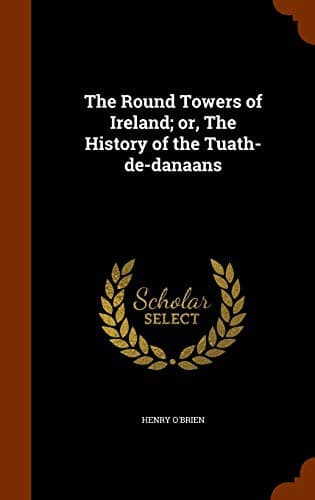
The Round Towers of Ireland; or, The History of the Tuath-De-DanaansO'Brien, Henry
Religion
The Round Towers of Ireland; or, The History of the Tuath-De-Danaans
O'Brien, Henry
Ireland -- Antiquities; Round towers -- Ireland
After reading these details it will be impossible, I conceive, for any
dispassionate mind to remain longer in suspense as to the origin of the
pyramids. The doubt, too, and obscurity in which they have been
heretofore enveloped can be explained with similar ease, if we but
remember the execration in which their Cushite founders were held by the
Egyptians, and their consequent disinclination to associate their name
with such splendid memorials. With this view, indeed, it is not at all
improbable but that active legislative measures were adopted to cancel and
suppress every vestige of proof which could tend to perpetuate the memory
of the obnoxious erectors. So that we must not wonder if, after a lapse of
years, their history was as great a riddle to the Egyptians themselves as
that of _our pyramids_ is to the Irish nation.
A collateral cause for this universal ignorance of their use and origin
was the probable absence of letters on the part of the Egyptians, until
now, for the first time, introduced by those learned Arabians; and though
any one who is acquainted with the oriental disquisitions of Wilfrid, and
the coincidences he establishes between the ancient history of Egypt and
the account given of the customs and dynasties of that kingdom, as drawn
from the Hindoo Puranas, will at once admit that “there must have been a
period when a Hindoo power had reigned in Egypt by right of conquest,” and
established therein the peculiar rites of their religion with the elements
of literature and social civilisation, yet it is probable that during
their sojourn, which, we have seen, was a continued series of warfare,
they kept themselves aloof from all intercourse with the natives, and
checked, as much as possible, the circulation of their science among them.
Some _sparks_ of it, however, must inevitably have transpired; and the
Egyptian intellect was too finely constituted to be insensible to its
value, or allow it to extinguish without food; so that, in the time of
Moses, and long after, their learning and accomplishments were courted by
the philosophers of the day, and were so eminently conspicuous, as to
become a proverb (Acts Apost. vii. 22). Homer, we all know, visited that
favoured land--so did Pythagoras--so did Solon, Thales, Plato, and
Eudoxus; in short, all the sages of antiquity, of whom we read so much,
and whom we peruse with such _recuperative_ pleasure, either finished
their education in that favoured school, or conversed with those who had
themselves done so.
The Egyptians are said to have been the first who brought the “rules of
government,” with the art of making “life easy” and “a people happy”--the
_true end_ of worldly politics--to a regular system. But much as they
excelled other nations in scientific lore, in nothing was their
superiority so conspicuous as in that _magic_ art which enabled them to
cope, for so long a time, and under such trying varieties, even with the
prophet and ambassador of God himself.
Public-domain text, read in full here on John Shaqi.
Reviews
Reviews
No reviews yet
Be the first to share your thoughts on this work.
Elsewhere in the archive
Join the Discussion
Join the discussion
Sign in to leave a comment or review.
Sign InorCreate an account