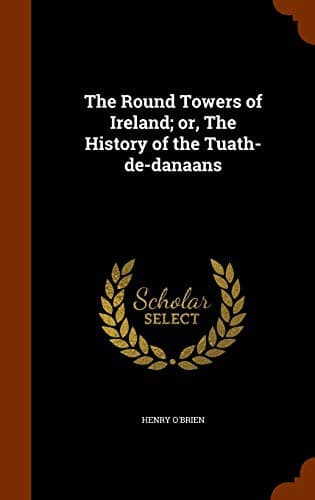
The Round Towers of Ireland; or, The History of the Tuath-De-DanaansO'Brien, Henry
Religion
The Round Towers of Ireland; or, The History of the Tuath-De-Danaans
O'Brien, Henry
Ireland -- Antiquities; Round towers -- Ireland
“What then was the site of the Eriene referred to? The editors and
commentators on the Zendavesta are inclined to discover it in Georgia, or
the Caucasian district; but the opinion must necessarily appear
unsatisfactory to anyone who will take into account the whole of the
record, and the succession of places there mentioned as the abodes of the
race. On the contrary, we there trace a gradual migration of the nation
from east to west, not as this hypothesis would tend to prove, from west
to east. The first abode which Ormuzd created for the exiled people was
Soghdi, whose identity with Sogdiana is sufficiently apparent; next Môore,
or Maroo, in Khorasan; then Bakhdi, or Balkh (Bactriana), and so on to
Fars itself, and the boundaries of Media or India. The original country of
Eriene must therefore lie to the east of Leed, and thus we are led, by the
course of tradition, to those regions which we have already referred to as
the scene of the traditions and fables of the nation, viz. the mountainous
tracts on the borders of Bucharia, the chain of Mustag and Beloorland, as
far as the Paropamisan range on the confines of Hindustan, and extending
northwards to the neighbourhood of the Altain chain. This savage and
ungenial region enjoys at present only a short summer, at the same time
that it contains the relics of an ancient world, which confirm, by
positive proof, the legend of the Vendidat, that anciently the _climate_
was of a _totally different character_. When the altered nature of their
original seats compelled the race to quit them, Ormuzd prepared for them
other places of repose and abundance, within the precincts of that
territory which has _preserved to the present day the appellation of Iran;
the nation carrying with them the name of Eriene, which is obviously the
same with Iran_.
“Jemshid, the father of his people, the most glorious of mortals whom the
sun ever beheld. In his day animals perished not: there was no want either
of water or of fruit-bearing trees, or of animals fit for the food of
mankind. During the light of his reign there was neither frost nor burning
heat, nor death, nor unbridled passions, nor the work of the Deevs. Man
appeared to retain the age of fifteen; the children grew up in safety as
long as Jemshid reigned the father of his people.[212]
“The restoration of such a golden age was the end of the legislation of
Zoroaster, who, however, built his code on a religious foundation
agreeably to the practice of the East; and the multifarious ceremonies he
prescribed had all reference to certain doctrines intimately associated
with his political dogmata; and it is absolutely necessary to bear in mind
their alliance, if we would not do injustice to one part or other of his
system.
Public-domain text, read in full here on John Shaqi.
Reviews
Reviews
No reviews yet
Be the first to share your thoughts on this work.
Elsewhere in the archive
Join the Discussion
Join the discussion
Sign in to leave a comment or review.
Sign InorCreate an account