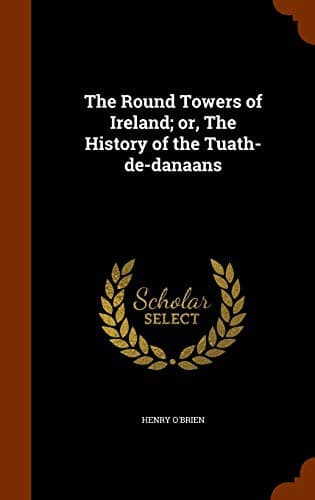
The Round Towers of Ireland; or, The History of the Tuath-De-DanaansO'Brien, Henry
Religion
The Round Towers of Ireland; or, The History of the Tuath-De-Danaans
O'Brien, Henry
Ireland -- Antiquities; Round towers -- Ireland
Thus palliated by types, Moses did, however, imbibe from the Egyptians all
the knowledge which they then possessed of the nature of their ceremonies;
and the record of the _Fall_, the _Deluge_, and the _Creation_ are the
direct transcripts of the instruction so conveyed. But though it is
undeniable, from their _symbols_, that the Egyptians must have been well
apprised of the _constitution_ of those rites, yet am I as satisfied as I
am of my physical motion, that the foldings of that _web_, in which they
were so mystically _doubled_, was lost to their grasp in the labyrinths of
antiquity.
Moses, therefore, could not have _learned_ from the Egyptians more than
the Egyptians themselves had _known_. He related the allegory as he had
_received_ it from them: and it is, doubtless, to his ignorance of its
_ambiguous_ interpretation, _accessible only through that language in
which it was originally involved_, that we are indebted for a
transmission, _so essentially Irish_.
The _Pish_-de-danaan dynasty which rose upon the ruins of the
_Tuath_-de-danaans, in _Iran_, was itself, in after ages, ejected from
that country. _Egypt_ was the retreat of their shattered fortunes; and
there, during their abode, under the name of the _Shepherd-kings_, they
erected the _Pyramids_, in honour of _Pith_, or _Padma_-devi, but at an
age long anterior to what may be presumed from Manetho.[308]
Previously, however, to their arrival in Egypt, Shinaar in Mesopotamia
afforded them an asylum. Here it was that Nimrod broke in:[309] and as I
have before but _transiently glanced_ at that circumstance, I shall now
revert to it with more precision.
Between the tenets of the _Pish_-de-danaans and those of their
_Tuath_-de-danaan predecessors, there was but a single point of
dissentient belief. The language, the customs, the manners and modes of
life of both were the same. To all intents and purposes they were one
identical people.
But as the former had imagined that the _Yoni_ alone was the author of
_procreation_, while the others claimed that honour for their own symbol,
the _Lingam_, an animosity ensued, which was not allayed even by the
consciousness, that _each_, secretly, worshipped the type of the _other’s_
creed.
The _goddess_, however, prevailed in the struggle, and her glories in Iran
were great and far spread. Monarchs bowed at the nod of her omnipotence,
and the earth swelled with the gestations of her praise.[310] “_Sed
ultima dies semper homini est expectanda._” A rude and a lawless swarm of
stragglers, headed by an adventurer of commanding abilities and determined
heroism, _deluged_, in turn, the _Boatmen_, or the _Noachidæ_,[311] and
swamped them in a _flood_, as _sanguinary_ and as _disastrous_ as that
which they had, themselves, before, brought upon the adversaries of their
zeal.
Public-domain text, read in full here on John Shaqi.
Reviews
Reviews
No reviews yet
Be the first to share your thoughts on this work.
Elsewhere in the archive
Join the Discussion
Join the discussion
Sign in to leave a comment or review.
Sign InorCreate an account