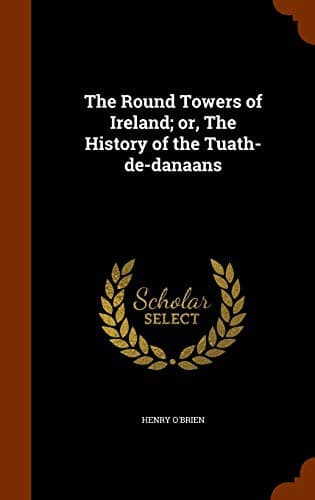
The Round Towers of Ireland; or, The History of the Tuath-De-DanaansO'Brien, Henry
Religion
The Round Towers of Ireland; or, The History of the Tuath-De-Danaans
O'Brien, Henry
Ireland -- Antiquities; Round towers -- Ireland
“What are _ages_ and the lapse of time,
Matched against _truths_ as lasting as sublime?
Can length of years on God Himself exact?
Or make that _fiction_ which was once a _fact_?
No--marble and recording brass decay,
And like the graver’s _memory_ pass away:
The works of man inherit, as is just,
Their author’s frailty, and return to dust;
_But truth divine for ever stands secure,
Its head is guarded, as its base is sure;
Fixed in the rolling flood of endless years,
The pillar of the eternal plan appears,
The raving storm and dashing wave defies,
Built by that Architect who built the skies_.”[379]
CHAPTER XXIII.
A very industrious contributor to the _Asiatic Researches_ has afforded
scope for some jests at his expense, because of the attempt which he has
made to identify the British islands with certain Western localities
commemorated in the writings of the Hindoos. Had he but known, however,
the coincidence of _our monuments_ with those _mysteries_ which the
Puranas record, how they mutually support and dovetail into each other, he
could not only have laughed to scorn the traducers of his services, but
fixed his fame upon a pinnacle of literary pride which no _undergrowl_ of
envy could have subverted.
But as it is, unacquainted with the history of the places which he left
behind him, and wading, therefore, through an ocean in which he had no
compass for his guide, he has, in his puerile endeavours to wrest the text
of the Puranas to external prejudices, effected more himself towards the
disparagement of his reputation, than what the combined influence of
interest and of scepticism could otherwise accomplish.
“There are,” say the Puranas, “many manifestations and forms of Bhagavan,
O Muni, but the form which resides in the _White Island_ is the primitive
one. Vishnu,” says the author, “recalling all his emanations into the
_White Island_, went into the womb, in the house of Vasu-devi; and on
this grand occasion he recalled all his emanations. Bama and Nrisinha are
complete forms, O Muni; but Crishna, the most powerful king of the _White
Island_, is the most perfect and complete of all Vishnu’s forms. For this
purpose Vishnu, from Potola, rejoins the body of Radhiceswara, the lord of
Radha, he who dwells in the _White Island_ with the famous _snake_, a
portion of his essence. The gods sent there portions of their own essences
to be consolidated into the person of Crishna, who was going to be
incarnated at Gocula.”[380]
The gist of the foregoing, Mr. Wilford would neutralise by this following
extract, which he gives as the substance of another notice in the same
documents, and which he considers himself as incredible:--
Public-domain text, read in full here on John Shaqi.
Reviews
Reviews
No reviews yet
Be the first to share your thoughts on this work.
Elsewhere in the archive
Join the Discussion
Join the discussion
Sign in to leave a comment or review.
Sign InorCreate an account