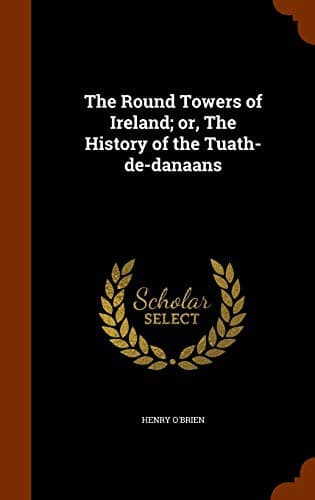
The Round Towers of Ireland; or, The History of the Tuath-De-DanaansO'Brien, Henry
Religion
The Round Towers of Ireland; or, The History of the Tuath-De-Danaans
O'Brien, Henry
Ireland -- Antiquities; Round towers -- Ireland
“Fortunately, it occurred to one of the lads (after his voice had become
hoarse with shouting), that the noise of miners’ hammers was often heard
at considerable distances through the coal works; in consequence of this
reflection, he took up a stone, which he frequently struck against the
sides of the cavern; the noise of this was at length heard by the workmen,
who, in their turn, adopted a similar artifice; by this means each party
was conducted towards the other, and the unfortunate adventurers
extricated time enough to behold the sun risen in full splendour, which
they had left the morning before just beginning to tinge the eastern
horizon. On examining this subterranean wonder, it was found to be a
complete gallery, which had been driven forward many hundred yards to the
bed of coal: that it branched off into numerous chambers, where miners had
carried on their different works: that these chambers were dressed in a
workmanlike manner: that pillars were left at proper intervals to support
the roof. In short, it was found to be an extensive mine, wrought by a set
of people at least as expert in the business as the present generation.
Some remains of the tools, and even of the baskets used in the works, were
discovered, but in such a decayed state, that on being touched, they
immediately crumbled to pieces. From the remains which were found, there
is reason to believe that the people who wrought these collieries
anciently, were acquainted with the use of iron, some small pieces of
which were found; it appeared as if some of their instruments had been
thinly shod with that metal.”
There is no question but that the era when those collieries were before
worked, was that in which the Tuath-de-danaans were masters of this
island. _Had it been at any later period, we could not fail having some
traditions relating thereto._ Iron, therefore, the last discovered of the
metals, as stated at page 115, must have been known to this people: and
the absence of any name for it in our vernacular language is accounted for
on the same principle as that by which those excavations themselves had
been so long concealed, namely, the distaste of their successors to such
applications, or the reluctance entertained to make them acquainted with
their worth.
Public-domain text, read in full here on John Shaqi.
Reviews
Reviews
No reviews yet
Be the first to share your thoughts on this work.
Elsewhere in the archive
Join the Discussion
Join the discussion
Sign in to leave a comment or review.
Sign InorCreate an account