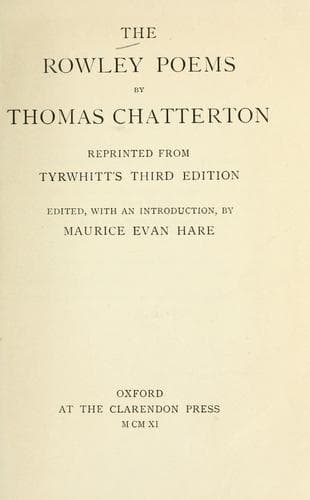
English poetry -- 18th century; Literary forgeries and mystifications -- Early works to 1800
Johne makes a jarre boute Lancaster and Yorke;
Bee stille, gode manne, and learne to mynde thie worke.
THE GOULER'S REQUIEM, by the same.
Mie boolie entes, adieu! ne moe the syghte
Of guilden merke shall mete mie joieous eyne,
Ne moe the sylver noble sheenynge bryghte
Schall fyll mie honde with weight to speke ytt fyne;
Ne moe, ne moe, alass! I call you myne: 5
Whydder must you, ah! whydder must I goe?
I kenn not either; oh mie emmers dygne,
To parte wyth you wyll wurcke mee myckle woe;
I muste be gonne, botte whare I dare ne telle;
O storthe unto mie mynde! I goe to helle. 10
Soone as the morne dyd dyghte the roddie sunne,
A shade of theves eche streake of lyght dyd seeme;
Whann ynn the heavn full half hys course was runn,
Eche stirryng nayghbour dyd mie harte afleme;
Thye loss, or quyck or slepe, was aie mie dreme; 15
For thee, O gould, I dyd the lawe ycrase;
For thee I gotten or bie wiles or breme;
Ynn thee I all mie joie and good dyd place;
Botte now to mee thie pleasaunce ys ne moe,
I kenne notte botte for thee I to the quede must goe. 20
THE ACCOUNTE OF W. CANYNGES FEAST.
Thorowe the halle the belle han sounde;
Byelecoyle doe the Grave beseeme;
The ealdermenne doe sytte arounde,
Ande snoffelle oppe the cheorte steeme.
Lyche asses wylde ynne desarte waste 5
Swotelye the morneynge ayre doe taste,
Syke keene theie ate; the minstrels plaie,
The dynne of angelles doe theie keepe;
Heie stylle the guestes ha ne to saie,
Butte nodde yer thankes ande falle aslape. 10
Thus echone daie bee I to deene,
Gyf Rowley, Iscamm, or Tyb. Gorges be ne seene.
THE END. [Illustration]
[NOTE ON THE GLOSSARY
The following glossary was compiled by Tyrwhitt before he had
discovered Chatterton's use of Kersey's and Bailey's dictionaries
(vide Introduction, p. xxviii) and a number of words were thus
necessarily left unexplained by him. The present editor has added,
in square brackets, explanations of all these words except about
half-a-dozen which neither Kersey's _Dictionarium Anglo-Britannicum
(K.)_, nor Bailey's _Universal Etymological Dictionary (B.)_, nor the
glossary to Speght's edition of Chaucer (_Speght_), nor the notes of
Prof. Skeat in his 1871 edition (_Sk._), nor any native ingenuity of
his own has served to elucidate.]
A GLOSSARY OF UNCOMMON WORDS IN THIS VOLUME.
Public-domain text, read in full here on John Shaqi.
Reviews
Reviews
No reviews yet
Be the first to share your thoughts on this work.
Elsewhere in the archive
Join the Discussion
Join the discussion
Sign in to leave a comment or review.
Sign InorCreate an account