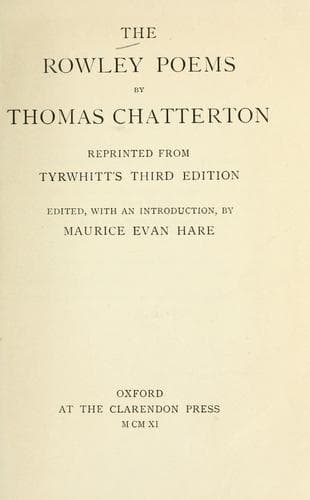
English poetry -- 18th century; Literary forgeries and mystifications -- Early works to 1800
Where _calked_ is a mere misprint for _calculed_, the reading of the
MSS. See the late Edit. ver. 11596.
It would be easy to add many more instances of words, _either not
ancient or not used in their ancient sense_, which repeatedly occur
in these poems, and must be construed according to those fanciful
significations which Skinner has ascribed to them. How that should
have happened, unless either Skinner had read the Poems (which, I
presume, nobody can suppose,) or the author of the Poems had read
Skinner, I cannot see. It is against all odds, that two men, living
at the distance of two hundred years one from the other, should
accidentally agree in coining the same words, and in affixing to them
exactly the same meaning.
I proceed to state some instances of words and interpretations which
are evidently founded upon misapprehensions of passages in Skinner.
ALYSE. Le. 29. G. 180. _Allow_. Chatterton. See before, p. 314.
Till I meet with this word, in this sense, in some approved author, I
shall be of opinion that it has been formed from a mistaken reading
of the following article in Skinner. "Alised, Authori Dict. Angl. apud
quem folum occurrit, exp. Allowed, ab AS. Alised, &c." In the Gothic
types used by Skinner f might be easily mistaken for a long s.
BESTOIKER. Æ. 91. _Deceiver_. Chatterton. See also Æ. 1064.
This word also seems plainly to have originated from a mistake in
reading Skinner. "Bestwike, ab AS. Berpican, Spican, _Decipere_,
Fallere, Prodere, Spica, Proditor, _Deceptor_." Chatterton in his
hurry read this as Bestoike, and formed a noun from it accordingly.
BLAKE. Æ. 178. 407. _Naked_. Chatterton. BLAKIED. E. III. 4. _Naked,
original_. Chatterton. See before, p. 317.
Skinner has the following article. "Blake _and_ bare, videtur ex
contextu prorsus _Nuda_, sort. q. d. Bleak _and_ Bare, dum enim nudi
fumus eóque aeri expositi, præ frigore pallescimus. Ch. sol. 184. p.
i. Col. i."
Chatterton has caught hold of _Nuda_, which in Skinner is the
exposition of _Bare_, as if it belonged to _Blake_.
HANCELLED. G. 49. _Cut off, destroyed_. Chatterton. _Hancelled_ from
erthe these Normanne hyndes shalle bee.
Skinner has the same word, which he thus explains. "Hanceled, exp. Cut
off, credo dici proprie, vel primario faltem, tantum de prima portione
feu segmento quod ad tentandam feu explorandam rem abscindimus, ut ubi
dicimus, _to_ Hansell _a pasty or a gammon of bacon_." Chatterton, who
had neither inclination nor perhaps ability to make himself master of
so long a piece of Latin, appears to have looked no further than
the two English words at the beginning of this explanation; and
understanding _Cut off_ to mean _Destroyed_, he has used _Hancelled_
in the same sense.
SHAP. Æ. 34. G. 18. _Fate_. Chatterton. SHAP-SCURGED. Æ. 603.
_Fate-scourged_. Chatterton.
_Shap_ haveth nowe ymade hys woes for to emmate. Stylle mormorynge
atte yer _shap_.----There ys ne house athrow thys _shap-scurged_
isle.
Public-domain text, read in full here on John Shaqi.
Reviews
Reviews
No reviews yet
Be the first to share your thoughts on this work.
Elsewhere in the archive
Join the Discussion
Join the discussion
Sign in to leave a comment or review.
Sign InorCreate an account