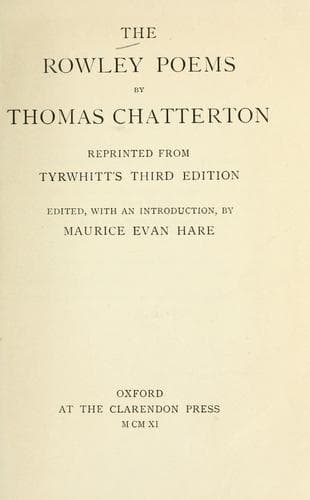
English poetry -- 18th century; Literary forgeries and mystifications -- Early works to 1800
[Footnote 1: I have chosen this _part_ of the internal evidence,
because the arguments, which it furnishes, are not only very decisive,
but also lie within a moderate compass. For the same reason of
brevity, I have confined my observations to a _part_ only of
this _part_, viz. to _words_, considered with respect to their
_significations_ and _inflexions_. A complete examination of this
subject _in all its parts_ would be a work of length.]
[Footnote 2: Of these varieties all, except the first, are more
properly varieties of _style_ than of _language_. The _local
situation_ of a writer may certainly produce a _provincial dialect_,
which will often differ essentially from the language used at the same
time in other parts of the same country. But this can only happen in
the case of persons of no education and totally illiterate; and such
persons seldom write. It is unnecessary however to discuss this point
very accurately, as nobody, I believe, will contend, that the poems
attributed to Rowley are written in any _provincial dialect_. If there
should be a few words in them, which are now more common at Bristol
than at London, it should be remembered that Chatterton was of
Bristol.]
[Footnote 3: It is not surprizing that Chatterton should have been
ignorant of a peculiarity of the English language, which appears to
have escaped the observation of a professed editor of Chaucer. Mr.
Urry has very frequently lengthened _verbs in the singular number_, by
adding _n_ to them, without any authority, I am persuaded, even from
the errors of former Editions or MSS. It might seem invidious to point
out living writers, of acknowledged learning, who have slipped into
the same mistake in their imitations of Chaucer and Spenser.]
[Footnote 4: This is a point so material to the following argument,
that, though it has never hitherto, I believe, been made a question,
it ought not perhaps to be assumed without some proof. It may be said,
that Chatterton was only the _transcriber_ of the Glossary as well
as of the Poems. If to such an attention we were to answer, that
Chatterton always declared himself the _author_ of the Glossaries,
we should be told perhaps, that with equal truth he always declared
Rowley to have been the author of the Poems. But (not to insist upon
the very different weight, which the same testimony might be allowed
to have in the two cases) it has happened luckily, that the Glossary
to the Poem, entitled "_Englysh Metamorphosis_," [See p. 196.] was
written down by Chatterton extemporally, without the assistance of any
book, at the desire and in the presence of Mr. Barrett. Whoever will
compare that Glossary with the others, will have no doubt of their
being all from the same hand.]
[Footnote 5: Printed at London, MDCLXXI. The part, which Chatterton
seems to have chiefly consulted, is that, which begins at Sign. U u u
u, and is entitled "_Etymologicon vocum omnium antiquarum Anglicarum,
quæ usque a Wilhelmo Victore invaluerunt, &c._"]
Public-domain text, read in full here on John Shaqi.
Reviews
Reviews
No reviews yet
Be the first to share your thoughts on this work.
Elsewhere in the archive
Join the Discussion
Join the discussion
Sign in to leave a comment or review.
Sign InorCreate an account