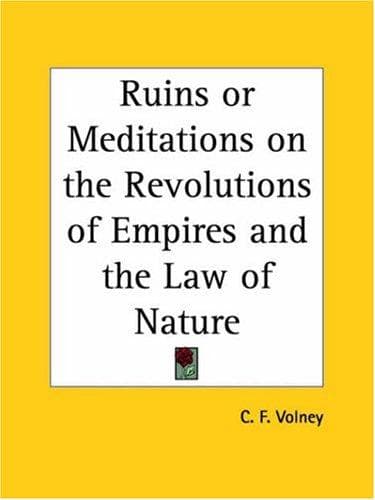
The Ruins; Or, Meditation on the Revolutions of Empires and the Law of NatureVolney, C.-F. (Constantin-François)
Religion
The Ruins; Or, Meditation on the Revolutions of Empires and the Law of Nature
Volney, C.-F. (Constantin-François)
Ethics; History -- Philosophy; Religions; Revolutions
"Long confined to simple appearances, they saw nothing in the movement
of the stars but an unknown play of luminous bodies rolling round the
earth, which they believed the central point of all the spheres; but as
soon as they discovered the rotundity of our planet, the consequences
of this first fact led them to new considerations; and from induction to
induction they rose to the highest conceptions in astronomy and physics.
"Indeed, after having conceived this luminous idea, that the terrestrial
globe is a little circle inscribed in the greater circle of the heavens,
the theory of concentric circles came naturally into their hypothesis,
to determine the unknown circle of the terrestrial globe by certain
known portions of the celestial circle; and the measurement of one
or more degrees of the meridian gave with precision the whole
circumference. Then, taking for a compass the known diameter of
the earth, some fortunate genius applied it with a bold hand to the
boundless orbits of the heavens; and man, the inhabitant of a grain of
sand, embracing the infinite distances of the stars, launches into the
immensity of space and the eternity of time: there he is presented with
a new order of the universe of which the atom-globe which he inhabited
appeared no longer to be the centre; this important post was reserved to
the enormous mass of the sun; and that body became the flaming pivot of
eight surrounding spheres, whose movements were henceforth subjected to
precise calculations.
"It was indeed a great effort for the human mind to have undertaken to
determine the disposition and order of the great engines of nature; but
not content with this first effort, it still endeavored to develop the
mechanism, and discover the origin and the instinctive principle. Hence,
engaged in the abstract and metaphysical nature of motion and its
first cause, of the inherent or incidental properties of matter, its
successive forms and its extension, that is to say, of time and space
unbounded, the physical theologians lost themselves in a chaos of
subtile reasoning and scholastic controversy.*
* Consult the Ancient Astronomy of M. Bailly, and you will
find our assertions respecting the knowledge of the priests
amply proved.
Public-domain text, read in full here on John Shaqi.
Reviews
Reviews
No reviews yet
Be the first to share your thoughts on this work.
Elsewhere in the archive
Join the Discussion
Join the discussion
Sign in to leave a comment or review.
Sign InorCreate an account