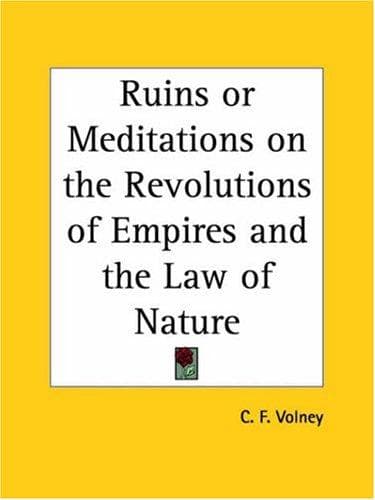
The Ruins; Or, Meditation on the Revolutions of Empires and the Law of NatureVolney, C.-F. (Constantin-François)
Religion
The Ruins; Or, Meditation on the Revolutions of Empires and the Law of Nature
Volney, C.-F. (Constantin-François)
Ethics; History -- Philosophy; Religions; Revolutions
* All the arguments of the spiritualists are founded on
this. See Macrobius, at the end of the second book, and
Plato, with the comments of Marcilius Ficinus.
"Here, then, is the Demi-Ourgos or grand artificer, constituted God
autocratical and supreme. In vain the ancient philosophy objected to
this by saying that the artificer himself must have had parents and
progenitors; and that they only added another step to the ladder by
taking eternity from the world, and giving it to its supposed author.
The innovators, not content with this first paradox, passed on to
a second; and, applying to their artificer the theory of the human
understanding, they pretended that the Demi-Ourgos had framed his
machine on a plan already existing in his understanding. Now, as their
masters, the naturalists, had placed in the regions of the fixed stars
the great primum mobile, under the name of intelligence and reason, so
their mimics, the spiritualists, seizing this idea, applied it to their
Demi-Ourgos, and making it a substance distinct and self-existent, they
called it mens or logos (reason or word). And, as they likewise admitted
the existence of the soul of the world, or solar principle, they found
themselves obliged to compose three grades of divine beings, which were:
first, the Demi-Ourgos, or working god; secondly, the logos, word
or reason; thirdly, the spirit or soul (of the world).* And here,
Christians! is the romance on which you have founded your trinity; here
is the system which, born a heretic in the temples of Egypt, transported
a pagan into the schools of Greece and Italy, is now found to be
good, catholic, and orthodox, by the conversion of its partisans, the
disciples of Pythagoras and Plato, to Christianity.
* These are the real types of the Christian Trinity.
"It is thus that God, after having been, First, The visible and various
action of the meteors and the elements;
"Secondly, The combined powers of the stars, considered in their
relations to terrestrial beings;
Thirdly, These terrestrial beings themselves, by confounding the symbols
with their archetypes;
Fourthly, The double power of nature in its two principal operations of
producing and destroying;
"Fifthly, The animated world, with distinction of agent and patient, of
effect and cause;
"Sixthly, The solar principle, or the element of fire considered as the
only mover;
Public-domain text, read in full here on John Shaqi.
Reviews
Reviews
No reviews yet
Be the first to share your thoughts on this work.
Elsewhere in the archive
Join the Discussion
Join the discussion
Sign in to leave a comment or review.
Sign InorCreate an account