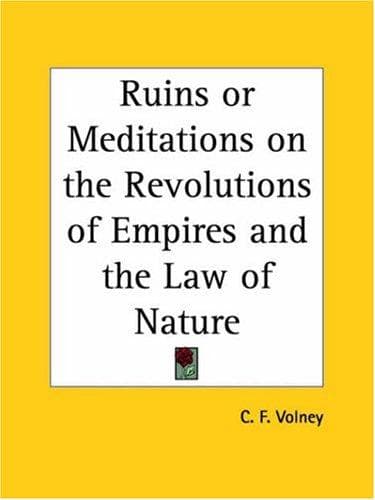
The Ruins; Or, Meditation on the Revolutions of Empires and the Law of NatureVolney, C.-F. (Constantin-François)
Religion
The Ruins; Or, Meditation on the Revolutions of Empires and the Law of Nature
Volney, C.-F. (Constantin-François)
Ethics; History -- Philosophy; Religions; Revolutions
* "The whole philosophy of the gymnosophists," says Diogenes
Laertius on the authority of an ancient writer, "is derived
from that of the Magi, and many assert that of the Jews to
have the same origin." Lib. 1. c. 9. Megasthenes, an
historian of repute in the days of Seleucus Nicanor, and who
wrote particularly upon India, speaking of the philosophy of
the ancients respecting natural things, puts the Brachmans
and the Jews precisely on the same footing.
"A fortuitous analogy between two leading ideas was highly favorable
to this coalition, and became the basis of a last system, not less
surprising in the fortune it has had in the world, than in the causes of
its formation.
"After the Assyrians had destroyed the kingdom of Samaria, some
judicious men foresaw the same destiny for Jerusalem, which they did not
fail to predict and publish; and their predictions had the particular
turn of being terminated by prayers for a re-establishment and
regeneration, uttered in the form of prophecies. The Hierophants,
in their enthusiasm, had painted a king as a deliverer, who was to
re-establish the nation in its ancient glory; the Hebrews were to become
once more a powerful, a conquering nation, and Jerusalem the capital of
an empire extended over the whole earth.
"Events having realized the first part of these predictions, the ruin of
Jerusalem, the people adhered to the second with a firmness of belief in
proportion to their misfortunes; and the afflicted Jews expected, with
the impatience of want and desire, this victorious king and deliverer,
who was to come and save the nation of Moses, and restore the empire of
David.
"On the other hand, the sacred and mythological traditions of preceding
times had spread through all Asia a dogma perfectly analogous. The cry
there was a great mediator, a final judge, a future saviour, a king,
god, conqueror and legislator, who was to restore the golden age upon
earth,* to deliver it from the dominion of evil, and restore men to the
empire of good, peace, and happiness. The people seized and cherished
these ideas with so much the more avidity, as they found in them a
consolation under that deplorable state of suffering into which they
had been plunged by the devastations of successive conquests, and the
barbarous despotism of their governments. This conformity between the
oracles of different nations, and those of the prophets, excited the
attention of the Jews; and doubtless the prophets had the art to compose
their descriptions after the style and genius of the sacred books
employed in the Pagan mysteries. There was therefore a general
expectation in Judea of a great ambassador, a final Saviour; when a
singular circumstance determined the epoch of his coming.
* This is the reason of the application of the many Pagan
oracles to Jesus, and particularly the fourth eclogue of
Virgil, and the Sybilline verses so celebrated among the
ancients.
Public-domain text, read in full here on John Shaqi.
Reviews
Reviews
No reviews yet
Be the first to share your thoughts on this work.
Elsewhere in the archive
Join the Discussion
Join the discussion
Sign in to leave a comment or review.
Sign InorCreate an account