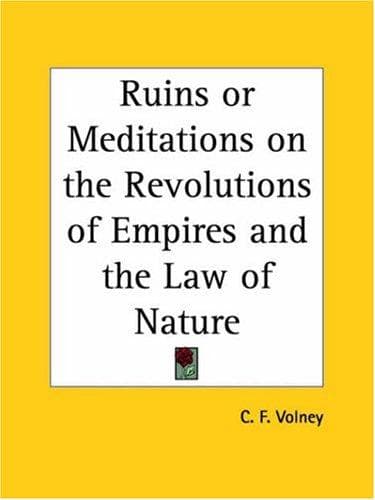
The Ruins; Or, Meditation on the Revolutions of Empires and the Law of NatureVolney, C.-F. (Constantin-François)
Religion
The Ruins; Or, Meditation on the Revolutions of Empires and the Law of Nature
Volney, C.-F. (Constantin-François)
Ethics; History -- Philosophy; Religions; Revolutions
A. When, conscious of the pernicious action of objects, we abandon
ourselves, nevertheless, to the impetuosity of our desires and
appetites: for example, when a man who knows that wine intoxicates, does
nevertheless drink it to excess.
Q. What is the result?
A. That the ignorance in which we are born, and the unbridled appetites
to which we abandon ourselves, are contrary to our preservation; that,
therefore, the instruction of our minds and the moderation of our
passions are two obligations, two laws, which spring directly from the
first law of preservation.
Q. But being born ignorant, is not ignorance a law of nature?
A. No more than to remain in the naked and feeble state of infancy. Far
from being a law of nature, ignorance is an obstacle to the practice of
all its laws. It is the real original sin.
Q. Why, then, have there been moralists who have looked upon it as a
virtue and perfection?
A. Because, from a strange or perverted disposition, they confounded the
abuse of knowledge with knowledge itself; as if, because men abuse the
power of speech, their tongues should be cut out; as if perfection and
virtue consisted in the nullity, and not in the proper development of
our faculties.
Q. Instruction, then, is indispensable to man's existence?
A. Yes, so indispensable, that without it he is every instant assailed
and wounded by all that surrounds him; for if he does not know the
effects of fire, he burns himself; those of water he drowns himself;
those of opium, he poisons himself; if, in the savage state, he does
not know the wiles of animals, and the art of seizing game, he perishes
through hunger; if in the social state, he does not know the course
of the seasons, he can neither cultivate the ground, nor procure
nourishment; and so on, of all his actions, respecting all his wants.
Q. But can man individually acquire this knowledge necessary to his
existence, and to the development of his faculties?
A. No; not without the assistance of his fellow men, and by living in
society.
Q. But is not society to man a state against nature?
Public-domain text, read in full here on John Shaqi.
Reviews
Reviews
No reviews yet
Be the first to share your thoughts on this work.
Elsewhere in the archive
Join the Discussion
Join the discussion
Sign in to leave a comment or review.
Sign InorCreate an account