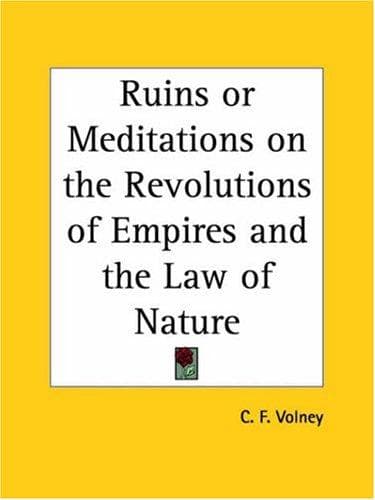
The Ruins; Or, Meditation on the Revolutions of Empires and the Law of NatureVolney, C.-F. (Constantin-François)
Religion
The Ruins; Or, Meditation on the Revolutions of Empires and the Law of Nature
Volney, C.-F. (Constantin-François)
Ethics; History -- Philosophy; Religions; Revolutions
A. Yes: according to the importance of the faculties, which they attack
or which they favor; and according to the number of persons in whom
those faculties are favored or injured.
Q. Give me some examples?
A. The action of saving a man's life is more virtuous than that of
saving his property; the action of saving the lives of ten men, than
that of saving only the life of one, and an action useful to the whole
human race is more virtuous than an action that is only useful to one
single nation.
Q. How does the law of nature prescribe the practice of good and virtue,
and forbid that of evil and vice?
A. By the advantages resulting from the practice of good and virtue
for the preservation of our body, and by the losses which result to our
existence from the practice of evil and vice.
Q. Its precepts are then in action?
A. Yes: they are action itself, considered in its present effect and in
its future consequences.
Q. How do you divide the virtues?
A. We divide them in three classes, first, individual virtues, as
relative to man alone; secondly, domestic virtues, as relative to a
family; thirdly, social virtues, as relative to society.
CHAPTER V.
OF INDIVIDUAL VIRTUES.
Q. Which are the individual virtues?
A. There are five principal ones, to wit: first, science, which
comprises prudence and wisdom; secondly, temperance, comprising sobriety
and chastity; thirdly, courage, or strength of body and mind; fourthly,
activity, that is to say, love of labor and employment of time; fifthly,
and finally, cleanliness, or purity of body, as well in dress as in
habitation.
Q. How does the law of nature prescribe science?
A. Because the man acquainted with the causes and effects of things
attends in a careful and sure manner to his preservation, and to the
development of his faculties. Science is to him the eye and the light,
which enable him to discern clearly and accurately all the objects
with which he is conversant, and hence by an enlightened man is meant a
learned and well-informed man. With science and instruction a man never
wants for resources and means of subsistence; and upon this principle a
philosopher, who had been shipwrecked, said to his companions, that were
inconsolable for the loss of their wealth: "For my part, I carry all my
wealth within me."
Q. Which is the vice contrary to science?
A. It is ignorance.
Q. How does the law of nature forbid ignorance?
A. By the grievous detriments resulting from it to our existence; for
the ignorant man who knows neither causes nor effects, commits every
instant errors most pernicious to himself and to others; he resembles a
blind man groping his way at random, and who, at every step, jostles or
is jostled by every one he meets.
Q. What difference is there between an ignorant and a silly man?
Public-domain text, read in full here on John Shaqi.
Reviews
Reviews
No reviews yet
Be the first to share your thoughts on this work.
Elsewhere in the archive
Join the Discussion
Join the discussion
Sign in to leave a comment or review.
Sign InorCreate an account