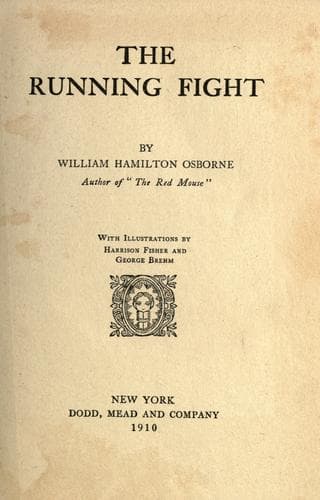
Murder -- Investigation -- Fiction; United States -- Social life and customs -- 20th century -- Fiction
" ... we can't have a thief in our employ," was the customary
remark. Some imputed to him hideous morals; others charged him with
drunkenness, but always with the same result.
In the beginning he had thought of leaving town and going West; but the
Beekman grit was in him and it declined to capitulate.
"I'll fight it out here, alone," he had told himself a thousand times,
"here, where I belong--where she is. I'll fight--I'll never run
away...."
The temptation to escape he had put behind him long ago, but there
were other things that assailed him. He had the name of everything
that was disreputable, he knew that. Even the newspapers from time
to time referred to him as being connected with fracases that never
had occurred, or if they had, had happened in his absence. Day after
day, night after night he walked the streets with shame clinging to
him. To-day he held his position, but never knowing when the merciless
hounds of the Wilkinson system would corrupt his employers and turn him
out. He grew shabby, shabbier, and all too swiftly, too. But he was
glad of one thing: his pride had never left him; he kept himself neat
and clean. He felt, though, that these were things that would slip from
him as he slumped down into the army of the unknown. Many times he had
to combat the temptation to take to drink, to drugs, to the comfortable
vices of the vagabond.
"I've got the name," he told himself, "the name,"--and unquestionably
Leslie believed it--for would not he have believed these things of his
dearest friends had the evidence been the same as it was in his own
case?--"And that's where Wilkinson was strong--he always had proofs....
Yes. I've got the name, why not the game?" he would reason, as he kept
slipping down, down, down.
But through it all the same instinct kept him straight. "I'll stick it
out alone," he kept saying over and over again. Leslie had told him
once that he was a man of destiny, and he still felt it. As long as
there was life there was hope. Help must come to him in some form some
day, and when he faced her, he must face her clean. Never once did he
blame her for his plight. He saw too well and clearly that she, too,
was the victim of the Wilkinson system, and all the more so because
she was Wilkinson's daughter. In Beekman's mind the truth was slowly
forcing itself that Leslie's plight was worse than his, for she was
unconsciously the innocent instrument of vengeance.
"I've got to stay decent for her sake," he kept repeating to himself.
But as time went on, one horrible temptation kept pressing, closing in
upon him.
Public-domain text, read in full here on John Shaqi.
Reviews
Reviews
No reviews yet
Be the first to share your thoughts on this work.
Elsewhere in the archive
Join the Discussion
Join the discussion
Sign in to leave a comment or review.
Sign InorCreate an account