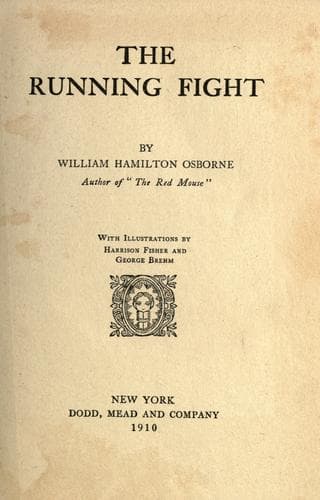
Murder -- Investigation -- Fiction; United States -- Social life and customs -- 20th century -- Fiction
And still he held on to her, held on until he got her underneath the
street lamps, where he looked into her face. She was worn and haggard,
but her dark, lustrous eyes were something to remember. "She must have
been very beautiful," he thought, and wondered.
"Look at me!" he said in a voice that startled her into consciousness;
"you've got to trust me! I'm going to take you home----"
"My home?" she cried feebly.
"Yes. Where is your home?"
The girl made no answer, but commenced to weep. At length, she said:
"If I had a home, do you suppose I would have attempted what you have
just prevented me from doing? Home? Let me go, please let me go!" and
again she fell to sobbing.
"Then I'll take you to my own home," he said; and added to himself:
"I'm good for one more day there at any rate."
"No, no, no!" she cried, trying to break away from him. "I want my
father, just father--Oh, father...."
"Don't fight against me. I'm going to help you to find your home, your
father. Come, trust me!"
And the girl, too weak to resist him any longer, allowed herself to be
led away by him.
* * * * *
In a cheap hotel on this same East Side a man sat among other men
of his own type, drinking with apparent gusto a huge glass of beer.
Between sips he smoked a pipe. His clothes were soiled, stained with
tobacco, they reeked with the odour of the place. He had just finished
telling a story to an English sailor, who slapped his thigh and howled
in glee.
"That's a good 'un, matey!" cried the sailor. "But I arn't got one to
match it, stow the luck!"
The storyteller's last chuckles had subsided and he had drained his
glass to the dregs, when suddenly a man entered the place and thrust
himself into the group that sat around the table. This newcomer was of
a different class from the others. He was tall, square, handsome, and
his air and clothes and manner betokened one of the better classes.
The genial storyteller set down his glass, grinned once more at the
English sailor, and then following the sailor's glance, looked up at
the stranger. He found the stranger was glancing down at him with an
intentness that was disconcerting, to say the least.
The stranger slowly extended his hand toward the group, his forefinger
levelling itself in the direction of the genial storyteller.
"I want to talk to you," he said.
The man at whom he pointed faltered for an instant. His first instinct
was to give the signal and get his cronies to bear down upon this
stranger and throw him to the ground.
The stranger--who was no other than Leech, an Assistant District
Attorney of the County of New York, who had become famous chiefly
as the lawyer who had sent Peter V. Wilkinson up for a ten-years'
term--saw the look, interpreted it correctly, but he only laughed in
the man's face.
"There are three of my men outside," he whispered, bending down, and
then straightened up once more. "Where can we talk?" he asked.
Public-domain text, read in full here on John Shaqi.
Reviews
Reviews
No reviews yet
Be the first to share your thoughts on this work.
Elsewhere in the archive
Join the Discussion
Join the discussion
Sign in to leave a comment or review.
Sign InorCreate an account