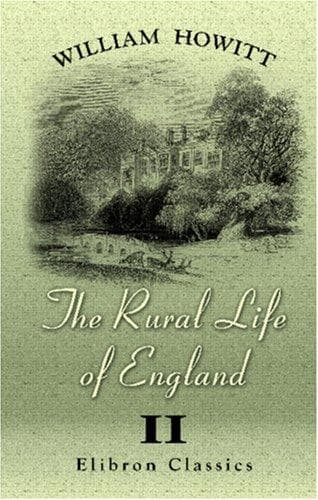
Country life -- England; England -- Social life and customs -- 19th century
and thence home.
My next visit to Hardwick was in the autumn of 1834. My companions now
were, my true associate for the last seventeen years, and one little boy
and girl, who, as we advanced up the park, rambled on before us in eager
delight. Twenty years had passed since that youthful party I have just
mentioned was there;--twenty years to me of many sober experiences; of
naturally extended knowledge; of observation of our old English houses
in various parts of the kingdom: but as I once more approached Hardwick,
I felt that it had lost none of its effect,--nay, that that effect was
actually increased: it was more unworldly, more unlike any thing else,
or any thing belonging to common life; more poetical, more crowned and
overshadowed with beautiful and solemn associations, than it was when I
first beheld it in my youth. The distance you have to advance, from the
moment you emerge from amongst the trees of the park into a full view of
the Hall, until you reach it, tends greatly to heighten its effect.
There it stands, bold and alone, on a wide unobstructed plain.
No trees crowd upon it, or break, for a moment, the view; it lifts
itself up in all its solemn and unique grandeur to the blue heavens,
like a fairy palace, in the days of old romance. It is a thing expressly
of by-gone times--darkened indeed by age, but not injured. Unlike modern
mansions, you see no bustle of human life about it; no gardens and
shrubberies; but wings of grey, and not very high walls, extending
to a considerable distance over the plain, from each end of the
house, inclosing what gardens there are, and paddocks. You see
no offices appended,--it seems a place freed from all mortal
necessities,--inhabited by beings above them. All offices, in fact, that
are not included within the regular walls of the house, are removed to a
considerable distance with the farm-yard. As you draw near, its grave
aspect strikes you more strongly; you become more sensible of its
loftiness, of the vast size of its windows, and of that singular parapet
which surmounts it. It is an oblong building, with three square towers
at each end, both projecting from, and rising much higher than, the body
of the building. The parapet surmounting these towers is a singular
piece of open-work of sweeping lines of stone, displaying the initials
of the builder, E. S.--Elizabeth Shrewsbury,--surmounted with the
coronet of an earl. On all sides of the house these letters and crown
strike your eye, and the whole parapet appears so unlike what is usually
wrought in stone, that you cannot help thinking that its singular
builder, old Bess of Hardwick, must have cut out the pattern in paper
with her scissars. It is difficult to say, whether this remarkable
woman had a greater genius for architecture or matrimony. She was the
daughter of John Hardwick of Hardwick, and sole heiress of this estate.
She married four times, always contriving to get the power over her
Public-domain text, read in full here on John Shaqi.
Reviews
Reviews
No reviews yet
Be the first to share your thoughts on this work.
Elsewhere in the archive
Join the Discussion
Join the discussion
Sign in to leave a comment or review.
Sign InorCreate an account