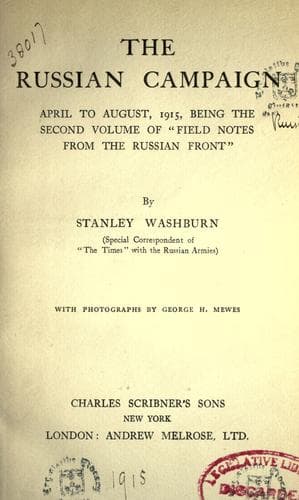
The Russian Campaign, April to August, 1915: Being the Second Volume of "Field Notes from the Russian Front"Washburn, Stanley
History
The Russian Campaign, April to August, 1915: Being the Second Volume of "Field Notes from the Russian Front"
Washburn, Stanley
World War, 1914-1918 -- Campaigns -- Eastern Front; World War, 1914-1918 -- Personal narratives
Here was the most curious sight that I have ever seen in war. The
rough-and-ready cavalrymen from the Caucasus with their great caps,
each as big as a bushel basket, all covered with wool about six inches
long, were lying about behind small earthworks on the fringe of the
woods peering along their rifle barrels which were pointed across the
river. On an almost similar elevation on the opposite side was the line
of the Austrian trenches. For once the sun was over our shoulders, and
in their eyes and not ours, so that I could safely walk to the edge of
the wood and study their works through my field glasses. Everything was
very quiet this particular afternoon, and I could see the blue-coated
figures of the enemy moving about behind their own trenches, as indeed
the Russians could with their naked eyes. The war has lasted so long
now, and the novelty has so worn off, that it is safe to do many things
that could not have been done in the early months. No one nowadays is
anxious to start anything unnecessary, and sniping is a bore to all
concerned, and it hardly draws a shot if one or two men are seen moving
about. It is only when important groups appear that shots are fired.
Not two hundred yards back in the woods were the bivouacs of the
reserves, and the hundreds and hundreds of the little ponies tethered
to trees. There they stood dozing in the summer sunshine, twitching
their tails and nipping each other occasionally. I have never seen
cavalry in the trenches before, much less cavalry with their horses so
near that they could actually wait until the enemy were almost in their
works and then mount and be a mile away before the trench itself was
occupied. In this rough country where the positions lend themselves
to this sort of semi-regular work, I dare say these peculiar types
of horsemen are extremely effective, though I question if they would
appear to the same advantage in other parts of the Russian operations.
As a matter of fact one of the regiments now here was formerly attached
to the Warsaw Front, but was subsequently removed from that army and
sent down to Bukovina as a place more suited to its qualities.
Public-domain text, read in full here on John Shaqi.
Reviews
Reviews
No reviews yet
Be the first to share your thoughts on this work.
Elsewhere in the archive
Join the Discussion
Join the discussion
Sign in to leave a comment or review.
Sign InorCreate an account