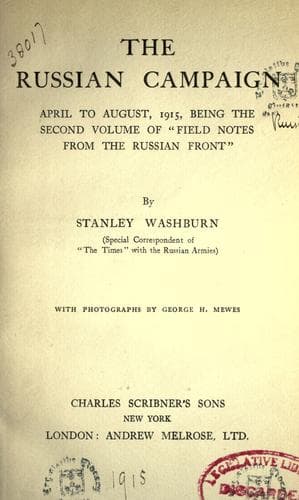
The Russian Campaign, April to August, 1915: Being the Second Volume of "Field Notes from the Russian Front"Washburn, Stanley
History
The Russian Campaign, April to August, 1915: Being the Second Volume of "Field Notes from the Russian Front"
Washburn, Stanley
World War, 1914-1918 -- Campaigns -- Eastern Front; World War, 1914-1918 -- Personal narratives
The Colonel was now in charge of the Lancer regiment and was, as I
learned, a great believer in the lance as a weapon. “Other things being
equal,” he told me, “I believe in giving the soldiers what they want.
They do want the lance, and this is proved by the fact that in this
entire campaign not one of my troopers has lost his lance. The moral
effect is good on our troops, for it gives them confidence, and it is
bad on the enemy, for it strikes terror into their hearts. Before this
war it was supposed that cavalry could never get near infantry. My
regiment has twice attacked infantry and broken them up both times. In
both cases they broke while we were still three or four hundred yards
distant, and of course the moment they broke they were at our mercy.”
For an hour or more we motored over the dusty roads before we dipped
over a crest and dropped down into a little village not far from the
Dniester, where were the head-quarters of the regiment that the Lancers
were coming in to relieve. As we turned the corner of the village
street a shrapnel shell burst just to the south of us, and I have an
idea that someone had spotted our dust as we came over the crest.
The cavalry here was a regiment drawn from the region of the Amur
river, and as they were just saddling up preparatory to going back
into reserve for a much-needed rest, I had a good chance to note the
condition of both men and mounts, which were excellent. The latter were
Siberian ponies, which make, I think, about the best possible horses
for war that one can find. They are tough, strong, live on almost
anything, and can stand almost any extremes of cold or heat without
being a bit the worse for it. These troops have had, I suppose, as hard
work as any cavalry in the Russian Army, yet the ponies were as fat as
butter and looked as contented as kittens. The Russians everywhere I
have seen them are devoted to their horses, and what I say about the
condition of the animals applies not only to the cavalry but even to
the transport, to look at which, one would never imagine that we were
in the twelfth month of war. The Colonel of the Amur Cavalry gave us
tea and begged us to stay on, but as it was getting late and the road
we had to travel was a new one to us, and at points ran not far from
the lines of the enemy, we deemed it wiser to be on our way. Some sort
of fight started after dark, and to the south of us, from the crests
of the hills that we crossed, we could see the flare of the Austrian
rockets and the occasional jagged flash of a bursting shell; further
off still the sky was dotted with the glow of burning villages. In fact
for the better part of the week I spent in this vicinity I do not think
that there was a single night that one could not count fires lighted by
the shells from the artillery fire.
Public-domain text, read in full here on John Shaqi.
Reviews
Reviews
No reviews yet
Be the first to share your thoughts on this work.
Elsewhere in the archive
Join the Discussion
Join the discussion
Sign in to leave a comment or review.
Sign InorCreate an account