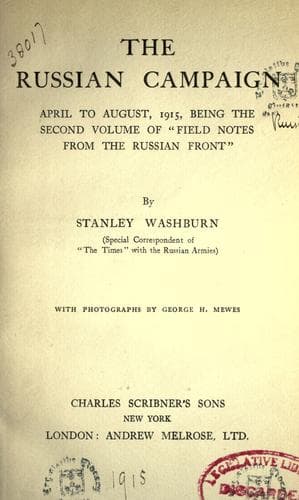
The Russian Campaign, April to August, 1915: Being the Second Volume of "Field Notes from the Russian Front"Washburn, Stanley
History
The Russian Campaign, April to August, 1915: Being the Second Volume of "Field Notes from the Russian Front"
Washburn, Stanley
World War, 1914-1918 -- Campaigns -- Eastern Front; World War, 1914-1918 -- Personal narratives
The General permitted Prince Mischersky to accompany me during my
visit to the positions on the following day. The Prince who is the
personal aide-de-camp of the Emperor, and a charming man, took me in
his own motor, and early we arrived at the head-quarters of a certain
army corps. From here we drove to the town of Krasnystav where was
the General of a lesser command. This point, though 14 versts from
the German gun positions, was under fire from heavy artillery, and
two 8-inch shells fell in the town as we entered, spouting bricks and
mortar in every direction while great columns of black smoke poured
from the houses that had been struck. While we were talking with
the General in his rooms, another shell fell outside with a heavy
detonation. From here we visited the division of another corps, where
we borrowed horses and rode up to their reserve trenches and had a look
at the troops, some of the most famous in Russia, whose name is well
known wherever the readers have followed the fortunes of the war. We
were perhaps 600 or 800 yards from the front line, and while we chatted
with the grizzled old commander of a certain regiment, the enemy began
a spasm of firing on the front line trench ahead of us, eleven shells
bursting in a few minutes. Then they suspended entirely and once again
quiet reigned through the woodland in which our reserves were.
From here by a narrow path we struck off to the west and worked our way
up into one of the new front line trenches which are laid out on an
entirely new plan, and have been in course of preparation ever since
the days of the fighting on the San. They are the best trenches I have
ever seen, and are considerably better in my opinion than those on the
Blonie line in front of Warsaw which, before this, were the best that
had ever come under my observation. Many things that I saw during this
day led me to the conclusion that the Russians were doing everything in
their power to prevent a repetition of the drive on the Dunajec. The
German line of communications here, as I am informed, runs viâ Rawa
Ruska, and owing to the difficulties of the terrain between where they
now stand and the Galician frontier, it will be very difficult for them
to retire directly south. Success in an action here, then, is of
great importance to them. If they attack and fail to advance, they must
count on the instant depression of the whole Austrian line, for the
Austrians even when successful have not been greatly enthusiastic. If
they are driven back, they must retire in the direction of Rawa Ruska,
across the face of the army standing to the east; they must strike
west through Poland, crossing the front of the army lying beside the
Vistula; or they must try to negotiate the bad roads south of them,
which present no simple problem. If the Russian centre can give them a
good decisive blow there is every reason to believe that both flanking
armies can participate pretty vigorously in an offensive. No one
Public-domain text, read in full here on John Shaqi.
Reviews
Reviews
No reviews yet
Be the first to share your thoughts on this work.
Elsewhere in the archive
Join the Discussion
Join the discussion
Sign in to leave a comment or review.
Sign InorCreate an account