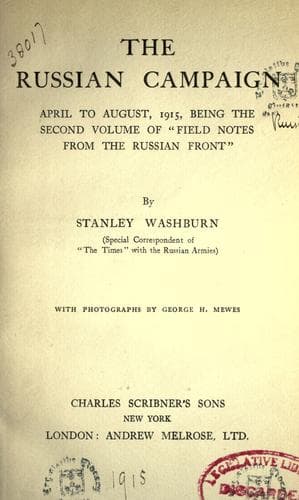
The Russian Campaign, April to August, 1915: Being the Second Volume of "Field Notes from the Russian Front"Washburn, Stanley
History
The Russian Campaign, April to August, 1915: Being the Second Volume of "Field Notes from the Russian Front"
Washburn, Stanley
World War, 1914-1918 -- Campaigns -- Eastern Front; World War, 1914-1918 -- Personal narratives
[Illustration: Russian armoured motor-car.]
There is no question that the German strategy aimed not merely at the
capture of Warsaw, but at the destruction or capture of the greater
part of the army defending the Polish capital. The German programme was
carefully prepared, and this time they had no isolated movements, but
two great movements developing simultaneously; one aimed to cut the
Warsaw-Petrograd lines from the North, and the other aimed at Warsaw
from the South. The time which has elapsed is not sufficient, nor is
the information available, to enable one to judge at this time whether
the Northern or Southern movement was the main German objective. I
was in the Cholm-Lublin Army head-quarters just before the heavy
fighting began, and was then of the opinion that the most important
German activity was contemplated on this sector. It is apparent by a
glance at the map, that an overwhelming success here would have been
of incredible importance to the enemy. Had they been able to destroy
this army as they did the one bearing the same number on the Dunajec in
May, they could have moved directly on Brest-Litowsk by Wlodava and cut
the Warsaw line of communications to the direct rear 180 versts away. A
rapid success here would have certainly resulted in just the disaster
that the Germans were hoping would be the outcome of their programme.
The movement on the North from the direction of Mlawa toward
Przasnys-Ciechanow was of course a direct threat on the
Warsaw-Petrograd line of communications. Success here would have forced
the evacuation of the city and a general change of the Russian line;
but even had it been a sweeping one, it had not the potentialities
of the calamity which a similar success on the Cholm line would have
had. Perhaps the Germans estimated both to be of approximately equal
importance, and a double success, occurring simultaneously, would
have undoubtedly repeated the Moukden fiasco on an infinitely larger
scale. It must be remembered that when this movement started, the
Russians in the South were at the end of a gruelling campaign of nearly
two months’ continuous warfare, in which, through lack of munitions,
they were obliged to withdraw under difficult and extremely delicate
circumstances. The army defending the Cholm-Lublin line was in name
the same that had been so very badly cut up six weeks earlier, and the
Germans no doubt believed that every one of the Russian Armies engaged
from the Bukowina to the Vistula had been so badly shaken up that any
effective resistance would be impossible. It was because their estimate
was so far out that their programme was doomed to disappointment.
[Illustration: The retreat from Warsaw. Wounded in a barn outside
Warsaw.]
Public-domain text, read in full here on John Shaqi.
Reviews
Reviews
No reviews yet
Be the first to share your thoughts on this work.
Elsewhere in the archive
Join the Discussion
Join the discussion
Sign in to leave a comment or review.
Sign InorCreate an account