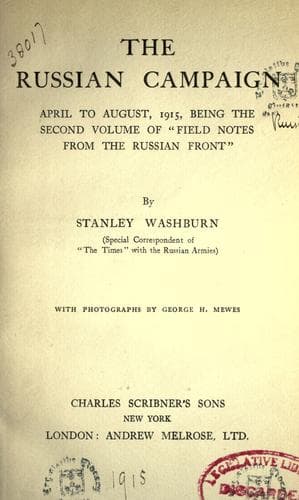
The Russian Campaign, April to August, 1915: Being the Second Volume of "Field Notes from the Russian Front"Washburn, Stanley
History
The Russian Campaign, April to August, 1915: Being the Second Volume of "Field Notes from the Russian Front"
Washburn, Stanley
World War, 1914-1918 -- Campaigns -- Eastern Front; World War, 1914-1918 -- Personal narratives
I have been able through certain channels, which I cannot at present
mention, to secure a considerable amount of information as to the
German side of this attack. When it became known in the trenches of
the enemy that these gases were to be used, there is reason to believe
that there was a protest from the soldiers against it. Many of the
Russians are charitable enough to take the point of view that the
common soldier resorts to these methods because he is forced to do so,
and they say that the German private rebelled at the idea of using so
hideous a method of conducting warfare. Others, while they accept the
story of the soldiers’ opposition, declare they only feared the effects
of the gas upon themselves. In any event there is evidence that their
officers told them that the gas was a harmless one, and would simply
result in putting the Russians into a state of unconsciousness from
which they would recover in a few hours, and by that time the Germans
would have been able to take their trenches without the loss of a man.
It was at first believed that the white powder placed on the straw was
the element of the poison gas, but it later appeared that this was
merely to produce a screen of heavy and harmless smoke behind which the
real operations could be conducted. The actual source of the gas was in
the trenches themselves.
Steel cylinders or tanks measuring a metre in length by perhaps 6
inches in width were let in end downwards into the floor of the trench,
with perhaps half of the tanks firmly bedded in the ground. At the head
of the cylinder was a valve, and from this ran a lead pipe over the
top of the parapet and then bent downwards with the opening pointed
to the ground. These tanks were arranged in groups of batteries the
unit of which was ten or twelve, each tank being perhaps two feet from
its neighbour. Between each group was a space of twenty paces. I have
not been able to learn the exact length of the prepared trenches, but
it was perhaps nearly a kilometre long. As soon as their line was
masked by the volumes of the screening smoke, these taps were turned
on simultaneously and instantly the thick greenish yellow fumes of the
chloral gas poured in expanding clouds upon the ground, spreading like
a mist upon the face of the earth.
Public-domain text, read in full here on John Shaqi.
Reviews
Reviews
No reviews yet
Be the first to share your thoughts on this work.
Elsewhere in the archive
Join the Discussion
Join the discussion
Sign in to leave a comment or review.
Sign InorCreate an account