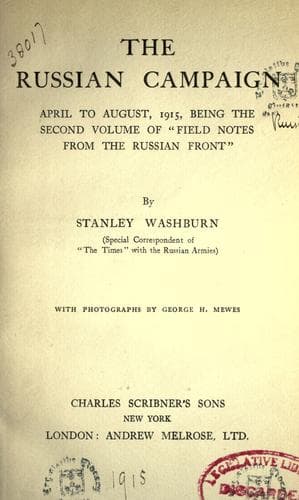
The Russian Campaign, April to August, 1915: Being the Second Volume of "Field Notes from the Russian Front"Washburn, Stanley
History
The Russian Campaign, April to August, 1915: Being the Second Volume of "Field Notes from the Russian Front"
Washburn, Stanley
World War, 1914-1918 -- Campaigns -- Eastern Front; World War, 1914-1918 -- Personal narratives
Though the unfortunates who succumbed suffered hideously, their lot
was an easy one compared to the lot of the miserable wretches who
lingered on and died later. One might almost say that even those that
are recovering have suffered so excruciatingly as to make life dear
at the price. Those who could be treated promptly have for the most
part struggled back to life. Time only will show whether they recover
entirely, but from evidence obtained, I am inclined to believe many
of them will be restored to a moderate condition of good health after
their lungs are healed. The first treatment employed by the Russians
when their patients come to the hospitals, is to strip them of all
clothing, give them a hot bath and put them into clean garments. This
is done for the protection of the nurses as well as of the victims,
for it was found that many of the helpers were overcome by the residue
of the fumes left in the clothing, so deadly was the nature of the
chemical compound used.
Even after these cases were brought to Warsaw and put into clean linen
pyjamas and immaculate beds, the gas still given out from their lungs
as they exhaled so poisoned the air in the hospital that some of the
women nurses were affected with severe headaches and with nausea. From
this it may be gathered that the potency of the chloral compound is
extremely deadly. The incredible part is, that out of the thousands
affected, hardly a thousand died in the trenches, and of the 1,300
to 1,500 brought to Warsaw, only 2 per cent. have died to date. It
is probably true that the Russian moujik soldier is the hardiest
individual in Europe; add to this the consideration that for ten months
none of them have been touching alcohol, which is probably one reason
for their astonishing vitality in fighting this deadly poison and
struggling back to life.
[Illustration: Respirator drill in the trenches.]
[Illustration: Austrians leaving Przemysl.]
After the victims are washed, every effort is made to relieve the
congestion. Mustard plasters are applied to the feet, while camphor
injections are given hypodermically, and caffeine or, in desperate
cases, digitalis is given to help the heart keep up its task against
the heavy odds. Next blood is drawn from the patient and quantities of
salt and water injected in the veins to take its place and to dilute
what remains. In the severer cases I am told that the blood even from
the arteries barely flows, and comes out a deep purple and almost as
viscous as molasses. In the far-gone cases it refuses to flow at all.
Public-domain text, read in full here on John Shaqi.
Reviews
Reviews
No reviews yet
Be the first to share your thoughts on this work.
Elsewhere in the archive
Join the Discussion
Join the discussion
Sign in to leave a comment or review.
Sign InorCreate an account