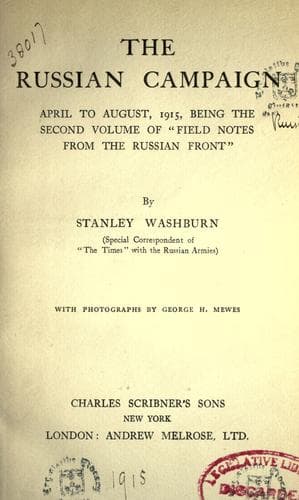
The Russian Campaign, April to August, 1915: Being the Second Volume of "Field Notes from the Russian Front"Washburn, Stanley
History
The Russian Campaign, April to August, 1915: Being the Second Volume of "Field Notes from the Russian Front"
Washburn, Stanley
World War, 1914-1918 -- Campaigns -- Eastern Front; World War, 1914-1918 -- Personal narratives
In fact it is but logical to expect the greatest suffering in the
future to be among children, for the gas hangs very low, and where a
six foot man might keep his nose clear of the fumes, a child of two or
three years old would be almost sure to perish. The live stock suffered
more or less, but there seems to have been a great difference in the
effects of the gases upon different kinds of animals. Horses were
driven almost frantic, cows felt it much less, and pigs are said not to
have been bothered appreciably. In its effects on plants and flowers
one notices a great range of results among different varieties. Pansies
were slightly wilted, snapdragons absolutely, while certain little blue
flowers whose name I do not know were scarcely affected at all. Some
of the tips of the grasses were coloured brown, while leaves on some
trees were completely destitute of any colour at all. I cannot explain
the varying effects. I have in my pocket a leaf two-thirds of which is
as white as a piece of writing paper while the remaining third is as
green as grass. On the same tree some leaves were killed and others not
affected at all. The effects also vary greatly in different parts of
the country. From what I could observe the gas had flowed to all the
low places where it hung for hours. In the woods it is said to have
drifted about with bad effects that lasted for several days.
What I have described above is the first effect on the country, but if
the Germans are to continue this practice for the rest of the summer I
think there must be effects which in the end will result in far more
injury to the peasants who are not prepared, than to the soldiers
who are taught how to combat the gases. In the first place it seems
extremely probable that this gas flowing to the low places will almost
invariably settle in the lakes, marshes and all bodies of still water
within 20 to 30 versts of the line. I am not sufficiently well grounded
in chemistry to speak authoritatively, but it seems not improbable that
the effect of this will be gradually to transform every small body of
water in this vicinity into a diluted solution of hydrochloric acid, a
solution which will become more and more concentrated with every wave
of gas that passes over the country-side. If this be the case Poland
may perhaps see huge numbers of its horses, cows and other live stock
slowly poisoned by chloral while the inhabitants may experience a
similar fate. With wet weather and moist soil will come a period when
the chloral will go into the earth in large quantities. I do not know
what effect this will have on the future of the crops, but I imagine
that it will not help the harvest this year, while its deleterious
effects may extend over many to come. In other words it seems as though
the Germans in order to inflict a possible military damage on the
Russians are planning a campaign, the terrible effects of which will
fall for the most part not on the soldiers at all but on the harmless
Public-domain text, read in full here on John Shaqi.
Reviews
Reviews
No reviews yet
Be the first to share your thoughts on this work.
Elsewhere in the archive
Join the Discussion
Join the discussion
Sign in to leave a comment or review.
Sign InorCreate an account