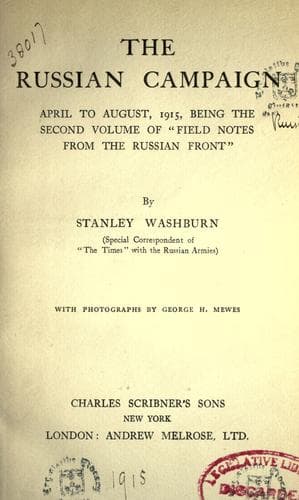
The Russian Campaign, April to August, 1915: Being the Second Volume of "Field Notes from the Russian Front"Washburn, Stanley
History
The Russian Campaign, April to August, 1915: Being the Second Volume of "Field Notes from the Russian Front"
Washburn, Stanley
World War, 1914-1918 -- Campaigns -- Eastern Front; World War, 1914-1918 -- Personal narratives
Personally I hate poking around in the broad daylight in this flat
country, but as I wanted to see the position where the gas was used
and did not want to wait until night, and as the Colonel was perfectly
agreeable, I suggested that we should proceed forthwith to the
positions. Before starting we were told that up to a few weeks ago no
one ever used the road in the daytime, because of its exposure to rifle
and artillery fire. “But now,” as the Colonel said, “for some reason or
other they are not shooting at individuals. Probably they are saving
their ammunition for Galicia. So if we walk apart we shall not be in
much danger. Anyway a man or two would be hard to hit with rifle fire,
and their artillery is rather poor here, and even if they fire at us I
think we shall not be killed.” We thanked him for his optimism and all
started off down the road that led to the positions. In view of his
suggestion about individuals being safe, I was not particularly happy
when five officers who had nothing else to do joined us. The first half
mile of the road led down an avenue of trees which effectively screened
us. After that the trees stopped and the great white road, elevated
about 5 feet above the surrounding country, impressed me as being the
most conspicuous topographical feature that I had seen in Poland. There
was not a bit of brush as big as a tooth-pick to conceal our party
walking serenely down the highway.
After we had got about 200 yards on this causeway the Colonel stopped
and pointed with his stick at a group of red brick buildings. “The
Germans were there,” translated the interpreter. “My,” I ejaculated
in enthusiasm at the idea that they had gone, “when did we retake the
position?” “Oh,” replied the interpreter officer, “not yet. They are
still there.” “Ah!” I said, lighting a cigarette, that my interest
might not seem too acute, “I should think they could see us.” The
linguist spoke a few words to the Colonel and then replied, “Oh, yes,
every move we make, but the Colonel thinks they will not shoot.” I
looked over at the brick buildings, behind which were the German
artillery positions, and I could swear they were not 2,000 yards away,
while a line of dirt nearer still showed the infantry trenches. For
myself I felt as large as an elephant, and to my eyes our party seemed
as conspicuous as Barnum’s circus on parade. However we continued our
afternoon stroll to the reserve trenches, where a soldier or two joined
our group. Five or six hundred yards up the road was the barricade
thrown across, held by the first line. An occasional crack of a rifle
reminded us that the look-outs in our trenches were studying the
movements in the German trenches a few hundred yards beyond. Finally
we left the road and came over a field and into the rear of our own
position, and to the scene of the German gas attacks four or five days
before.
Public-domain text, read in full here on John Shaqi.
Reviews
Reviews
No reviews yet
Be the first to share your thoughts on this work.
Elsewhere in the archive
Join the Discussion
Join the discussion
Sign in to leave a comment or review.
Sign InorCreate an account