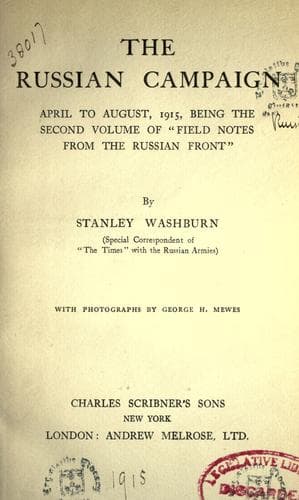
The Russian Campaign, April to August, 1915: Being the Second Volume of "Field Notes from the Russian Front"Washburn, Stanley
History
The Russian Campaign, April to August, 1915: Being the Second Volume of "Field Notes from the Russian Front"
Washburn, Stanley
World War, 1914-1918 -- Campaigns -- Eastern Front; World War, 1914-1918 -- Personal narratives
The point of view that I found at Ivanov’s staff was this. Russia with
her long front could not be strong everywhere at once. Her railroad
system and her industrial organization were in no way equal to the
German. Their sudden concentration was irresistible, and almost from
the start the Russians realized that they would have to go back. It
was hoped that the Germans could not maintain their ascendancy of
ammunition and strength beyond the San. Indeed, for a few days there
was something of a lull in which the Russians made gains in certain
places. Then the flow of ammunition was resumed, and from that time it
was pretty well understood that the Grodek line, and Lwow, would be
held only as rearguard actions to delay the German advance, and to take
from them the maximum loss at the minimum sacrifice. This particular
staff, in whose hands rested the conduct of the whole manœuvre, had
then the task of withdrawing these armies over this vast front in such
order and symmetry that as they retired no one should overlap the
flanks of the other, and that no loopholes should occur where an enemy
could get through. With these numerous armies, operating in all kinds
of countries with all sorts of lines of communications, falling back
before fierce assaults from an enemy superior in guns and men, the
performance of getting them safely back on to a united line where they
could once more make a united stand, must, I think, take its place in
history as one of the greatest military manœuvres that has ever been
made.
I had just come from Petrograd where the greatest gloom prevailed
in regard to the evacuation of Lwow, and I was surprised to find
that no one here attached any great importance to Lwow. One officer
of general’s rank remarked, “We do not believe in holding untenable
military positions for moral effect. Lwow is of no great value to us
from a military point of view, and the way the line developed it was
impossible to stay there without great risk. So we left. By and by we
will go back and take it again when we have more ammunition.” This was
the first time that I heard this statement, but since then I have heard
it at least a hundred times made by officers of all ranks from generals
down to subalterns. All agreed that it was disappointing to come back
after having fought so many months in taking Galicia, but I did not
find one man who was in the least depressed; and from that day to this
I have not heard in the army an expressed fear, or even a suggestion,
that there might be a possibility that Russia would not prove equal
to her task. The Russians as a race may be a bit slow in reaching
conclusions, but once they get their teeth set I think there are no
more stubborn or determined people in the world.
Public-domain text, read in full here on John Shaqi.
Reviews
Reviews
No reviews yet
Be the first to share your thoughts on this work.
Elsewhere in the archive
Join the Discussion
Join the discussion
Sign in to leave a comment or review.
Sign InorCreate an account