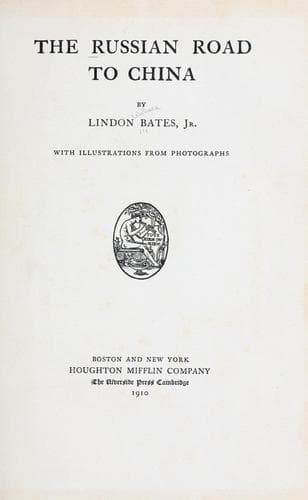
China -- Description and travel; Siberia (Russia) -- Description and travel; Velikaia Siberskaia magistral
All through the morning, hundreds of riders and horses have been making
for the starting-point, twenty _li_ (about seven miles) distant. The
jockeys are the smallest boys available: young red-cheeked lamas,
perched bareback on the shaggy racing-ponies. The monks, who are
stewards of the course, have with much shouting finally, at the hour,
lined them up in a long row, facing Urga. One thousand ponies have been
reported as entering. It is a regiment of boys. A signal starts the
whole cavalcade together. The thousand small jockeys shout at once. A
thousand whips come down on flanks. Two thousand heels dig into the
ponies’ withers. Over the irregular plain tear the racers, dodging
around gullies, stumbling in marmot-holes, galloping helter-skelter
amid furious yells. At length they come within sight of Urga. Crowds,
mounted, have gone out to follow them in. The shouts redouble, the
people become frantic; the riders yell at one another, and the horses
are as wild as their masters.
_Shabniars_ and cardinals get to their feet as the cavalcade appears.
The Living God’s heavy eyes brighten up with interest. His chief
soul-mate waves a jewelled hand and chatters excitedly with a lama
of the guard. The foremost rider is close at hand now, the jockey,
wriggling like an eel and almost on the neck of his pony, yelling and
slashing. The field thunders behind. The leader nears the pavilion,
his pony is on the fierce final spurt,--a last cut of the whip, and in
triumph, amid the deafening roar of the populace, the winner passes the
line. Many other riders come in at his heels, but most straggle off
to either side of the course when they see that the finish is lost.
The victor is caught up by the priests and is brought before Gigin,
where he lies on his stomach in adoration. He receives a gift, and is
pensioned for life. The horse’s owner receives a good price for the
animal, which is added to the Gigin’s stable. The mule-cart of the
Buddha is then brought up and he is loaded in. The yellow bishops mount
their steeds, and back to his palace goes the Living God. Thus ends the
great Urga race.
There are other athletic tournaments during the season; most important
of these is the championship wrestling-bout, which every year decides
whether laymen or clergy are the better sportsmen. The Gigin’s pavilion
fronts a ring, with dressing-tents on either side. From one emerges a
layman. He advances by huge jumps and prostrates himself before the
deity. Next, palms on the ground, like a great frog, he leaps into
the ring. The chosen lama executes the same pass from the other side.
They meet, jumping like game-cocks, with quick breaks. At length the
clergyman gets a leg. In an instant he heaves up on it, and over goes
the black man,--out! The whole assembled populace raises a stupendous
howl. Bout succeeds bout, with differing champions and varying issues.
Partisanship is intense. The clergy usually win in these matches, and
have long held the championship.
Public-domain text, read in full here on John Shaqi.
Reviews
Reviews
No reviews yet
Be the first to share your thoughts on this work.
Elsewhere in the archive
Join the Discussion
Join the discussion
Sign in to leave a comment or review.
Sign InorCreate an account