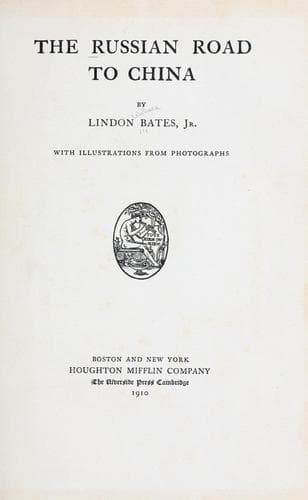
China -- Description and travel; Siberia (Russia) -- Description and travel; Velikaia Siberskaia magistral
Through this skeleton history can be traced the structure of the modern
state, as in the struggle for survival may be found the root and early
warrant of her governmental system. Every element, physical and ethnic,
was, and still is, a handicap. Russia is not protected by the ramparts
of the sea; she is surrounded on all sides by nations with whom her
history has been that of perennial conflict. In place of a compacted,
well-peopled country, she has an empire extended gradually from frozen
Nova Zembla to Afghanistan, from the Danube mouth to Behring’s arctic
sea. She is a land of many distinct peoples, as foreign to each other
as Lithuanians and wild Kirghis; as alien in religion as Catholic and
Mohammedan. She is divided into one knows not how many tribes, numbers
of them completely barbarous. Her eastern and south-eastern frontiers
call for defense across vast and vacant stretches. Her northern and
western borders are occupied by Finns and Poles, unforgetful forever of
their own days of sovereignty, naturally and rightly jealous for the
memories and the prerogatives that are its legacy.
With the eastern problem living from the first on her immediate border,
with her many tribes wayward, Russia early strove to fuse her empire
into national unity. In old Poland had been seen the fearful price
which feebleness and disunion pay to fate. How much greater was the
menace to polyglot Russia, were her master-grip to relax! That she
should hold a strong hand over the elements that ever threatened her
disruption was the first national necessity. This supreme obligation
to herself in her entirety compelled a firm, commanding, centralized
authority. The mould that was to shape such metal had need of rigidity
and unyielding strength. To meet these race-desires, not as a
purposeless tyranny but as the fruit of a long evolving system, arose
the autocracy.
The system reached its climax in the most absolute administration of
modern times at the period of the American Revolution; the “Government
Statute of 1775” meshed all things and all men into the institutions
of despotism; Russia groaned under the iron rule of a Nicholas, yet
rejoiced in the belief that strength was there, and sure defense from
domestic disunion and foreign aggression; then, in the Crimea, came a
revelation of the inefficiency of the bureaucratic juggernaut. Despite
the stubborn valor of the defenders of Sevastopol, despite the gallant
efforts of the aged autocrat, the glory of Russia went down in the
blaze of her city and her fleet.
The old régime had failed. Even the Czar, before he died, could read
the lesson but could not act. How pathetic the words of the failing
monarch: “My successor may do what he will, I cannot change.”
Public-domain text, read in full here on John Shaqi.
Reviews
Reviews
No reviews yet
Be the first to share your thoughts on this work.
Elsewhere in the archive
Join the Discussion
Join the discussion
Sign in to leave a comment or review.
Sign InorCreate an account