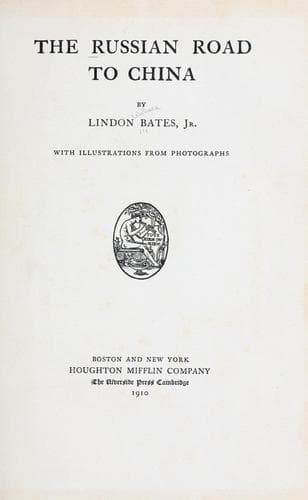
China -- Description and travel; Siberia (Russia) -- Description and travel; Velikaia Siberskaia magistral
Jacov meanwhile is making earnest inquiry of the “old one.”
“How are your cows, Dimitri Ivan’ich? Your horses, are they well? And
your sheep? All well? And have you had good crops? Is there still
plenty of pasture-land in this village? _Good!_ GOOD!--and how is your
wife?”
Poor withered wife; she is bustling around looking after the children,
and trying to help her daughter-in-law. Not so the “old one,” the
ancient man of the family to whom these courteous questions are
addressed. The patriarch stopped his labors at fifty, and sits
slumbering away his second prospective half-century in honored
idleness. “Everybody works but father!”
The samovar is humming now, and the table is decked with a
homespun-linen cloth ready for the _obeid_. The first formality, as
dinner is about to begin, must be observed. The various members of the
family turn, one after another, toward the ikons, reverently crossing
themselves. Then the host produces a bottle of a colorless liquid,
shakes it up and down, and brings the bottom sharply against his palm.
The cork shoots out, and he pours into a little glass a drink of the
national beverage, vodka, which one is supposed to swallow at a gulp.
Every time a guest enters, a bottle of vodka is brought out, costing
49¼ kopecks, half the average day-laborer’s pay in this district. On
feast-days the visitors go from house to house drinking,--and these
_prasdniks_ number some fifty-two days in the Russian year. Every
business deal is baptized with vodka. Every family festival, the
return of a son from the army, the marriage of a daughter,--all are
vodka-soaked. As one passes through villages on a saint’s day, he
may meet a dozen reeling figures and hear the maudlin songs from the
courtyards where the men have gathered. The part played by vodka in the
people’s life is appalling.
In the house now, all, beginning with the “old one,” partake of this
stimulant, solemnly gulping down their fiery potions. Then the family
sits down in due rank and order, the “old one” in the cosiest corner,
with the samovar convenient to his hand. You, as the guest, are beside
him on the bench that lines the wall, then comes Jacov, next the son,
then Ivan Kurbski the _yamshik_, and on stools along the inner side of
the table, the grandmother and assorted infants. The mother alternates
between the table and the oven.
The samovar is tapped for tea as the first course of the evening. For
all who come, tea is the obligatory offering, in a cup if the visitor
be familiar, but for special honor in a glass with a ragged lump of
sugar hammered from a big cone-shaped loaf. This one nibbles as he
drinks, for sugar is a luxury, not to be used extravagantly. The brown
rye-bread, which has been thawed at the gaping oven-door, is next
brought out, and raw blubber-like fat pork, in little squares, eaten
as butter, and boiled potatoes, and the boiled eggs, curdled from the
freezing.
Public-domain text, read in full here on John Shaqi.
Reviews
Reviews
No reviews yet
Be the first to share your thoughts on this work.
Elsewhere in the archive
Join the Discussion
Join the discussion
Sign in to leave a comment or review.
Sign InorCreate an account