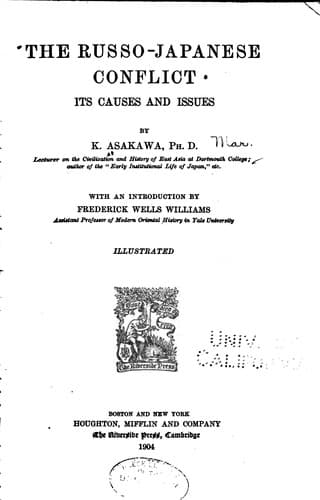
The Russo-Japanese Conflict: Its Causes and IssuesAsakawa, Kan'ichi
History
The Russo-Japanese Conflict: Its Causes and Issues
Asakawa, Kan'ichi
Russo-Japanese War, 1904-1905; Russo-Japanese War, 1904-1905 -- Causes
Unsatisfactory as the Manchurian Agreement of April 8, 1902, appeared to
Great Britain and Japan, they refrained from entering any protest
against its conclusion. They probably preferred the imperfect obligation
the Convention imposed upon the contracting parties to an indefinite
prolongation of the dangerous conditions which had prevailed. What
remained for them and for China was to watch the conduct of Russia in
Manchuria and test her veracity according to their own interpretations
of the Agreement. In the mean time, the questions which had existed
between China and the Powers were being one after another disposed of;
the distribution of the indemnities was finally agreed upon on June 14,
the Provisional Government of Tien-tsin by the Powers came to an end on
August 15, and the rendition of the city to the Chinese authorities was
accomplished. The date set for the evacuation of the southwest of the
Sheng-king Province up to the Liao River, October 8, drew on, and the
evacuation took place. The Tartar General Tsêng-chi had received an
Imperial mandate to take over from the hands of the Russians the
specified territory and its railways, even before the middle of
September,[429] and, on October 28, Prince Ching was able to state to
Sir Ernest Satow: “Their Excellencies the Minister Superintendent of
Northern Ports and the Military Governor of Mukden have now severally
reported by telegram that all the railways outside the Great Wall have
been handed back, and that the southwest portion of the Mukden
(Sheng-king) Province as far as the Liao River has been completely
evacuated by Russian troops.”[430] But what was evacuation? Some troops
may have been sent to European Russia, others to different stations in
Siberia, including the strategically important Nikolsk, near the eastern
border of Manchuria, and still others to Mongolia, where Russian forces
were reported to have suddenly increased, until in December they were
said to have numbered about 27,000.[431] No small number were also
transferred to Port Arthur[432] and Vladivostok.[433] It was, however,
alleged by several observers that the main part of the so-called
evacuation meant nothing more than the transferring of Russian troops
from Chinese towns and settlements to the rapidly developing Russian
settlements and quarters within Manchuria. It was reported from various
sources[434] that along the 2326 versts of the railroads there were
about eighty so-called depots, each two to five square miles in extent,
which had been marked out as the sites of new Russian settlements, and
in many cases as stations of the railway guards. The most important
line, connecting Port Arthur with Harbin, was studded with such depots
at every fifteen or twenty miles. In many of these depots were to be
seen extensive barracks built of brick, one at Liao-yang, for example,
being capable of holding 3000 men, and another at Mukden, in the
building of which bricks of the wall of the Chinese Temple of Earth were
Public-domain text, read in full here on John Shaqi.
Reviews
Reviews
No reviews yet
Be the first to share your thoughts on this work.
Elsewhere in the archive
Join the Discussion
Join the discussion
Sign in to leave a comment or review.
Sign InorCreate an account