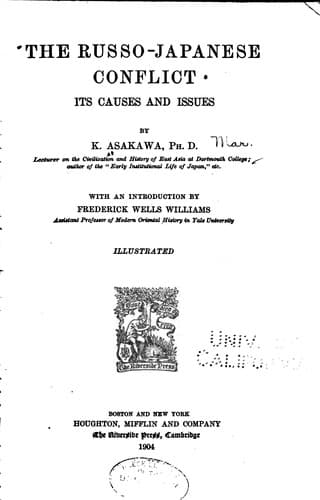
The Russo-Japanese Conflict: Its Causes and IssuesAsakawa, Kan'ichi
History
The Russo-Japanese Conflict: Its Causes and Issues
Asakawa, Kan'ichi
Russo-Japanese War, 1904-1905; Russo-Japanese War, 1904-1905 -- Causes
An early reply was urged by Mr. Kurino at least four times,[660] but,
even so late as February 1, Count Lamsdorff declined even to name the
date on which his reply would be given;[661] and, indeed, the reply[662]
which was being framed was found later to have contained substantially
the same points as the three previous replies—points some of which had
been repeatedly and unequivocally demonstrated to be entirely
irreconcilable with the vital interests of Japan. Just at this time, the
activity of the Russian forces in the East seemed to have been
accelerated: on January 21, numbers of infantry and artillery left Port
Arthur and Dalny for the Korean frontier, soon to be followed by
contingents from Liao-yang; on the 28th, Viceroy Alexieff ordered the
troops on the Yalu to be placed upon a war footing; on February 1, the
Governor of Vladivostok warned the Japanese Commercial Agent at the port
to prepare for withdrawing his compatriots to Habarofsk, as he had
received instructions from his Government and was ready to proclaim
martial law at any time; and, on the 3d, all the war-vessels located at
Port Arthur, excepting one, steamed out of the harbor.[663]
It was now considered by the Japanese Government that the critical point
had been reached. The Cabinet members and Privy Councilors held a
conference on February 3, and again, on the next day, before the Throne.
On February 5, at 2 P. M., two notes were telegraphed to Mr. Kurino, the
one communicating Japan’s decision to break off negotiations which had
not been met with proper consideration and had become useless, and to
reserve to herself the right to pursue an independent course of action,
in order to safeguard her interests and rights and to protect her
position menaced by Russia; and the other stating that Japan had been
obliged to sever her now valueless diplomatic relations with the Russian
Government. We subjoin the entire texts of the telegraphic messages from
Baron Komura to Mr. Kurino inclosing the above-mentioned notes:—
“Further prolongation of the present situation being intolerable,
the Imperial Government have decided to terminate the pending
negotiations, and to take such independent action as they may deem
necessary to defend our position menaced by Russia, and to protect
our rights and interests. Accordingly you are instructed,
immediately upon receipt of this telegram, to address to Count
Lamsdorff the following signed note:—
“‘The Undersigned, Envoy Extraordinary and Minister Plenipotentiary
of His Majesty the Emperor of Japan, has the honor, in pursuance of
instructions from his Government, to address to His Excellency the
Minister of Foreign Affairs of His Majesty the Emperor of all the
Russias the following communications:—
Public-domain text, read in full here on John Shaqi.
Reviews
Reviews
No reviews yet
Be the first to share your thoughts on this work.
Elsewhere in the archive
Join the Discussion
Join the discussion
Sign in to leave a comment or review.
Sign InorCreate an account