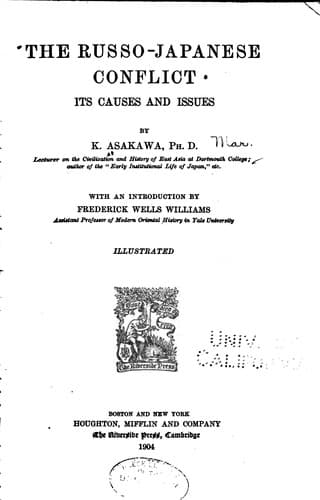
The Russo-Japanese Conflict: Its Causes and IssuesAsakawa, Kan'ichi
History
The Russo-Japanese Conflict: Its Causes and Issues
Asakawa, Kan'ichi
Russo-Japanese War, 1904-1905; Russo-Japanese War, 1904-1905 -- Causes
“We, by the Grace of Heaven, the Emperor of Japan, seated on the
Throne occupied by the same dynasty from time immemorial, do hereby
make proclamation to all our loyal and brave subjects:—
“We hereby declare war against Russia. We command our army and navy
to carry on hostilities against her with all their strength, and we
also command all our officials to make effort, in pursuance of their
duties and in accordance with their powers, to attain the national
aim, with all the means within the limits of the law of nations.
“We deem it essential to international relations, and make it our
constant aim, to promote the pacific progress of our Empire in
civilization, to strengthen our friendly ties with other States, and
thereby to establish a state of things which would maintain enduring
peace in the East, and assure the future security of our Empire
without injury to the rights and interests of other Powers. Our
officials also perform their duties in obedience to our will, so
that our relations with all Powers grow steadily in cordiality.
[Illustration:
BARON DE ROSEN
_Late Russian Minister at Tokio_
]
“It is thus entirely against our wishes that we have unhappily come
to open hostilities against Russia.
“The integrity of Korea has long been a matter of the gravest
concern to our Empire, not only because of the traditional relations
between the two countries, but because the separate existence of
Korea is essential to the safety of our Empire. Nevertheless,
Russia, despite her explicit treaty pledges to China and her
repeated assurances to other Powers, is still in occupation of
Manchuria, and has consolidated and strengthened her hold upon it,
and is bent upon its final absorption. Since the possession of
Manchuria by Russia would render it impossible to maintain the
integrity of Korea, and would, in addition, compel the abandonment
of all hope for peace in the Far East, we expected, in these
circumstances, to settle the question by negotiations and secure
thereby a permanent peace. With this object in view, our officials
by our order made proposals to Russia, and frequent conferences were
held during the last half year. Russia, however, never met such
proposals in a spirit of conciliation, but by her prolonged delays
put off the settlement of the pending question, and, by ostensibly
advocating peace on the one hand, and on the other secretly
extending her naval and military preparations, sought to bring about
our acquiescence. It is not possible in the least to admit that
Russia had from the first a sincere desire for peace. She has
rejected the proposals of our Empire; the safety of Korea is in
danger; the interests of our Empire are menaced. At this crisis, the
guarantees for the future which the Empire has sought to secure by
peaceful negotiations can now only be sought by an appeal to arms.
Public-domain text, read in full here on John Shaqi.
Reviews
Reviews
No reviews yet
Be the first to share your thoughts on this work.
Elsewhere in the archive
Join the Discussion
Join the discussion
Sign in to leave a comment or review.
Sign InorCreate an account