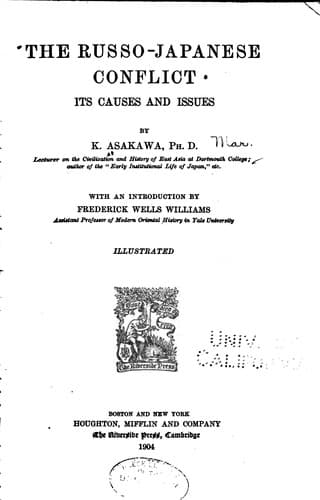
The Russo-Japanese Conflict: Its Causes and IssuesAsakawa, Kan'ichi
History
The Russo-Japanese Conflict: Its Causes and Issues
Asakawa, Kan'ichi
Russo-Japanese War, 1904-1905; Russo-Japanese War, 1904-1905 -- Causes
“On January 16, after receipt of the last Japanese proposals, the
Russian Imperial Government at once proceeded to examine them. On
January 25 Mr. Kurino, the Japanese Minister at St. Petersburg, in
reply to his inquiry, was informed that the Czar had intrusted the
consideration of these proposals to a special conference, which was
to meet on January 28, and that his Majesty’s decision would
probably not be given before February 2.[670] On the last-named date
the Czar gave orders to prepare a draft of definite instructions for
the Russian Minister at Tokio on the basis of the deliberations of
the special conference. On the day following, three telegrams were
dispatched to Viceroy Alexieff, containing the full text of a draft
statement, the reasons which prompted the Russian Government in
making some modifications in the Japanese proposals, and the general
instructions for the Russian Minister at Tokio concerning the
presentation of the reply to the Japanese Government. In order to
save time, identical telegrams were sent direct to Baron Rosen.
“On February 4, forty-eight hours before the receipt of the news of
the rupture of diplomatic relations by Japan, Count Lamsdorff
notified the Japanese Minister of the dispatch to Baron Rosen of the
Russian proposals in reply to the Japanese note.[671] On February 5,
a message arrived from the Viceroy stating that he had heard from
the Baron that the latter had received the Russian reply. On the
6th, at four o’clock in the afternoon, the Japanese Minister, quite
unexpectedly, handed to the Russian Minister of Foreign Affairs two
notes, the first of which notified the rupture of negotiations on
the pretext that Russia was evading a reply[672] to the Japanese
proposals, while the second announced the breaking off of diplomatic
relations, and added that the Japanese Minister, with the staff of
the Legation, would leave St. Petersburg on the 10th. These notes
were accompanied by a private letter from the Japanese Minister to
Count Lamsdorff, in which the hope was expressed that the rupture of
diplomatic relations would be confined to as short a time as
possible.
“On the same day, Admiral Alexieff, Baron Rosen, and all the Russian
Representatives in Peking, Tokio, and the capitals of the great
Powers were informed by urgent telegrams of the rupture of
diplomatic relations with Japan and the issue of our Imperial order
for the withdrawal of the Russian Legation from Tokio. The said
circular dispatch laid the responsibility of all consequences that
might ensue on the Japanese Government.[673]
Public-domain text, read in full here on John Shaqi.
Reviews
Reviews
No reviews yet
Be the first to share your thoughts on this work.
Elsewhere in the archive
Join the Discussion
Join the discussion
Sign in to leave a comment or review.
Sign InorCreate an account