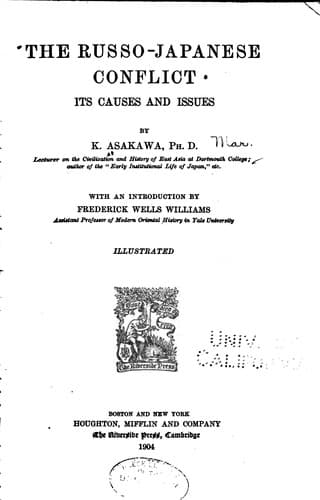
The Russo-Japanese Conflict: Its Causes and IssuesAsakawa, Kan'ichi
History
The Russo-Japanese Conflict: Its Causes and Issues
Asakawa, Kan'ichi
Russo-Japanese War, 1904-1905; Russo-Japanese War, 1904-1905 -- Causes
It should not be forgotten, at the same time, that Japan had all the
while been taking precautionary measures in the most careful and
exhaustive manner, not only in military and naval affairs, but also in
other matters connected therewith. The difference between the Russian
and Japanese attitude may thus be stated: Russia apparently played the
three-fold game of employing sharp diplomacy at Seul and Peking, of
strengthening her control over Manchuria and the Korean frontier, and
of endeavoring at once to intimidate Japan by vast warlike measures,
and to evade her overtures till she might be compelled to acquiesce in
the situation to be at length perfected by Russia; Japan expressed her
wishes in straightforward language, and relied upon her negotiations
with Russia, which she, in spite of extremely trying circumstances,
conducted with the utmost cordiality and patience, but at the same
time prepared for any emergency in which the unconciliating attitude
of Russia might probably result. It will perhaps be always regretted
by many that the control of Russian diplomacy throughout the
negotiations rested in the hands of those who seemed to fail to grasp
the exact state of Japan’s mind in this greatest crisis of her
national existence.
Footnote 664:
_N.-R._, No. 48.
Footnote 665:
_Ibid._, No. 49.
Footnote 666:
Mr. Kurino left St. Petersburg on the 10th, and the next day saw the
departure of Baron Rosen from Tokio. It was generally believed that
the former had once sincerely desired that a satisfactory agreement
between Russia and Japan should be effected. As for Baron Rosen, every
one surmised that the respected gentleman was little responsible for
the conduct of Russian diplomacy, of which he was regarded as an
unfortunate agent. From a personal point of view, the sudden departure
of both from their posts had something tragic about it, and Baron
Rosen’s situation was deeply sympathized with by the Japanese people.
Footnote 667:
From the English translation in the London _Times_, February 11, 1904,
p. 3.
Footnote 668:
The rescript appeared in the _Kwampō_, February 10, 1904, extra. An
authoritative English translation, which has been slightly altered in
our text in order to bring it nearer to the original language, was
published in the London _Times_, February 12, 1904, p. 3.
Footnote 669:
The London _Times_, February 19, 1904, p. 3.
Footnote 670:
The reports from Mr. Kurino do not agree with this statement of
Russia. According to the former, it was on January 26, not the 25th,
that Count Lamsdorff referred to the conference to be held on the
28th. The date February 2 in this connection does not appear till we
reach Mr. Kurino’s dispatch of January 28. Moreover, on January 30,
the Count told him that he could not tell him the exact date when the
Russian reply would be sent. See _N.-R._, Nos. 43, 45, 47.
Footnote 671:
Public-domain text, read in full here on John Shaqi.
Reviews
Reviews
No reviews yet
Be the first to share your thoughts on this work.
Elsewhere in the archive
Join the Discussion
Join the discussion
Sign in to leave a comment or review.
Sign InorCreate an account