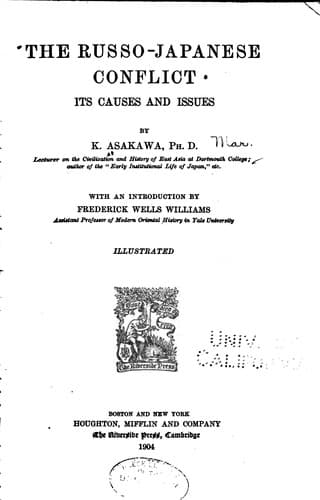
The Russo-Japanese Conflict: Its Causes and IssuesAsakawa, Kan'ichi
History
The Russo-Japanese Conflict: Its Causes and Issues
Asakawa, Kan'ichi
Russo-Japanese War, 1904-1905; Russo-Japanese War, 1904-1905 -- Causes
It is impossible to imagine in the history of the Russo-Japanese
conflict a more striking indication of the new situation it has opened
than this Protocol of February 23, 1904. It is at once a culmination of
past events and a background for future activities. It sums up the
failures of the past experience and calls forth innumerable new problems
and difficulties. It will be seen, in the first place, that the
agreement is limited by no fixed term; it exists for all time. Then the
fundamental problem of the Japanese-Korean relations is revealed here in
this Protocol in a clear outline, and is solved in the most logical
manner. The problem may be stated thus: Japan’s interest and conviction
demand that Korea should be independent, prosperous, and powerful; but
Korea neither could nor would be so. One remembers how Japan had
struggled to solve this problem, ever since she overthrew the feudal
régime of her own Government in 1868 and entered upon a new career as a
nation. At first, in 1876, she declared Korea independent, and opened a
few of her ports to the world’s trade. Korea did not desire and China
could not tolerate the independence. The result was the war of 1894–5,
which succeeded in forcing the independence of Korea. The latter,
however, proved neither more desirous nor more capable of an independent
career than she was under Chinese sovereignty, while at the time China’s
position was merely replaced by that of a more active Power, Russia.
Japan seemed, after her costly war, which, it is not too much to say,
alone had earned the sovereign rights of Korea, to acquiesce in the
altered situation to such an extent as to admit Russia into a
partnership with herself in the nonintervention in Korea.[685] Bitter
was Japan’s experience in this artificial arrangement. Korea would not
strive for a freer life any more than Russia would abstain from
incessant interference.[686] Thus the conviction was every year more
forcibly and painfully impressed upon Japan’s mind that the threatening
situation in the East arose from the two fundamental defects of the
existing arrangement: first, Korea’s independence would be illusory so
long as her administrative system remained, as it did, corrupt to the
core, but no reform would result from a system of non-interference;
second, no joint reform in Korea would be possible so long as one of the
contracting parties to the agreements of 1896 and 1898 found in Korea’s
decay the source of its influence over her. In short, in order to guard
the common interests of Japan and Korea, the former would be constrained
to reform the latter even against her will; and, again, in order to
effect a thoroughgoing reform, Japan would be obliged to part ways with
Russia in Korea. One half of the Russo-Japanese negotiations in 1903–4
hinged on Japan’s desire for a free hand in Korea in the interest of
reform. The negotiations having failed, and Russia having withdrawn from
Public-domain text, read in full here on John Shaqi.
Reviews
Reviews
No reviews yet
Be the first to share your thoughts on this work.
Elsewhere in the archive
Join the Discussion
Join the discussion
Sign in to leave a comment or review.
Sign InorCreate an account